
Social Media
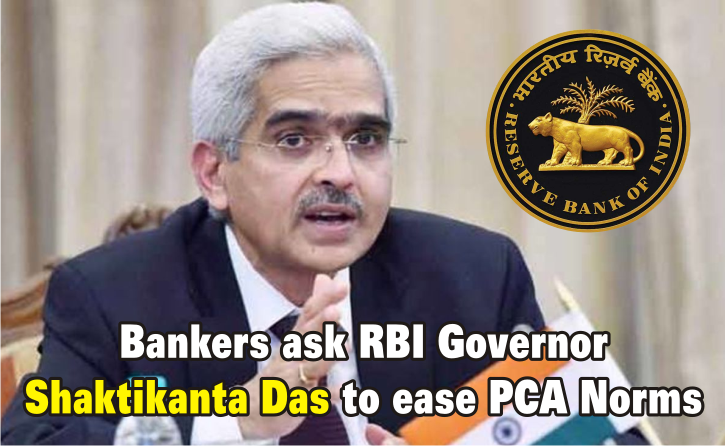
Bankers ask RBI Governor Shaktikanta Das to ease PCA Norms
Prompt Corrective Action (PCA) is triggered when banks breach certain regulatory requirements like capital, asset quality (tracked in terms of the net Non-Performing Assets ratio) and profitability, and Reserve Bank of India (RBI) has on 11out of the 21 state-owned banks imposed PCA, which imposes lending and other restrictions on weak banks. These are Allahabad Bank, United Bank of India, Corporation Bank, IDBI Bank, UCO Bank, Bank of India, Central Bank of India, Indian Overseas Bank, Oriental Bank of Commerce, Dena Bank and Bank of Maharashtra.,
- RBI has issued a PCA framework to maintain sound financial health of banks.
- RBI PCA framework was introduced in December 2002 as a structured mechanism, along the lines of the US Federal Deposit Insurance Corporation PCA framework.
- RBI PCA framework was reviewed in 2017 on the recommendations of the working group of the Financial Stability and Development Council on Resolution Regimes for Financial Institutions in India and Financial Sector Legislative Reforms Commission.
- PCA is imposed on banks on breaching of risk thresholds for following identified areas of monitoring:
- CRAR: Capital to Risk Weighted Assets Ratio,
- NPA: Net Non-Performing Assets and
- RoA Return on Assets.
- PCA facilitates banks to take corrective measures in a timely manner, in order to restore their financial health.
- PCA is intended to encourage banks to eschew certain riskier activities, improve operational efficiency and focus on conserving capital to strengthen them.
- PCA framework is not intended to constrain the performance of normal operations of the banks for the general public.
Bad loans in the banking system have risen sharply over the last three years, with gross NPAs crossing the ₹10 lakh crore mark. The rise in NPAs has impacted banks’ profitability and eroded their capital.
Government wants RBI to relax the PCA norms so that economic growth is not impacted due the restrictions on lending on banks.
Chief executives of seven Mumbai based public sector banks, who met the new Reserve Bank of India (RBI) Governor Shaktikanta Das on Thursday 13 December 2018, requested the central bank to relax PCA norms on the ground that it was hurting credit off-take. Bankers highlighted the challenges they are facing to boost loan growth with the expectation that the central bank take a decision in Friday’s board meeting regarding easing PCA norms so that restrictions are withdrawn from some of the lenders. But the crucial meeting of the central board of RBI on 14 December took no significant decisions on review of PCA norms and easing of liquidity situation for NBFCs – another important factor in tightening overall credit supply in the country and impacting economic growth, as per Moody’s Investors Service report.
Related Articles
-
 Feb 27, 2017 07:18 am







Related Articles
-

Created at: May 29, 2019
-

Created at: May 28, 2019
-

Created at: May 27, 2019
-

Created at: May 27, 2019
-

Created at: May 26, 2019
-
Created at: May 26, 2019
-

Created at: May 25, 2019