
Social Media
Cassini Spacecraft Ends Historic Exploration of Saturn
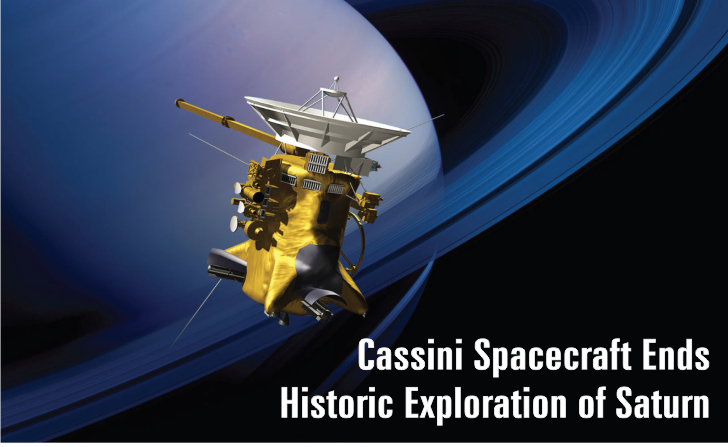
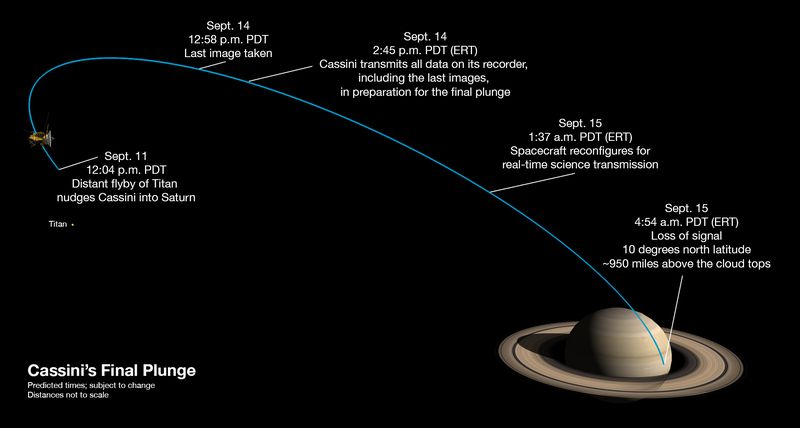
Cassini Spacecraft: with two elements: Cassini orbiter and Huygens probe, launched from Cape Canaveral, Florida in October 1997, spent seven years in transit, arrived at Saturn in July 2004, followed by 13 years orbiting Saturn; was the first spacecraft to observe Saturn – the ringed planet from orbit, ended its mission – the historic exploration of Saturn with epic dive into the Saturn on Friday September 15, 2017. Scientists say Cassini-Huygens mission taught us nearly everything we know about Saturn today and transformed our understanding of the Saturn system and the way we think about life elsewhere in the solar system.
- Cassini, a joint endeavor of NASA (National Aeronautics and Space Administration of United States), ESA (European Space Agency), and Italian Space Agency was the first mission to orbit Saturn and explore its environs in detail.
- Cassini project cost $3.9 billion and included scientists from 27 nations, disintegrated as it dove into Saturn’s atmosphere at a speed of 120700 km per hour.
- Cassini-Huygens mission was conceived in 1982, just after the two NASA Voyager spacecraft flew past Saturn and whetted the appetites of planetary scientists for more in-depth exploration, particularly with regard to the mysterious moon
- Cassini had been touring the Saturn system since arriving there in 2004, performing a detailed, up-close study of the planet, its rings and moons.
- In 2005, the Cassini orbiter released a Lander called Huygens on Titan, marking the first and only such landing in the outer solar system, on a celestial body beyond the asteroid belt. Huygens entered the murky atmosphere of Titan, Saturn’s biggest moon, and descended via parachute onto its surface – the most distant spacecraft landing to date. (Lander is a spacecraft designed to land on the surface of a planet or moon).
- Cassini’s cloud-piercing radar imaging system eventually mapped the moon, revealing networks of rivers, lakes and seas flowing with liquid methane.
- In complement to Huygens’ dazzling revelations about Titan, the Cassini orbiter performed 127 of its own close flybys of Titan, with many more distant encounters.
- Cassini went on to orbit Saturn 294 times, repeatedly using Titan’s gravity to alter its trajectory, setting up flybys of multiple moons and giving the spacecraft different perspectives on Saturn and its vast ring system as its seasons slowly changed.
- Over the course of its 13-year mission, Cassini executed 2.5 million commands, carried out 360 engine burns, completed 162 targeted flybys of Saturn’s moons, took more than 453,000 images and discovered six previously unknown moons, covering 4.9 billion miles since launch in 1997.
- Most important, the spacecraft collected 635 gigabits of data resulting in nearly 4000 peer-reviewed scientific papers.
- Saturn’s moon Enceladus is now known to harbor a saltwater ocean lurking beneath an icy crust, with hydrothermal vents on the seafloor and jets of water ice and vapor spewing into space from cracks in the crust near the South Pole, as shown by sequence of shots.
- Cassini flew through the plumes and detected organic compounds, indicating that the tiny moon could, in theory, harbor a habitable environment and, possibly, life beneath its relatively thin crust, an unexpected discovery that ranks among Cassini’s major achievements.
Pioneer 11 in 1979 followed by Voyager 1 and 2 in the 1980s are the other three spacecraft that have flown by Saturn but none have studied Saturn in such detail as Cassini, named after the French-Italian astronomer Giovanni Domenico Cassini, who discovered in the seventeenth century that Saturn had several moons and a gap between its rings.
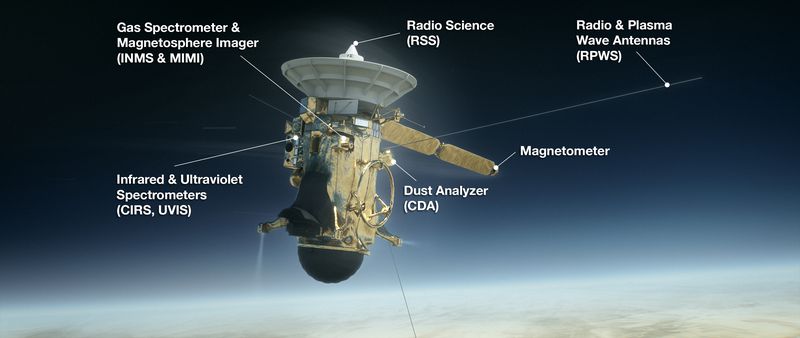
Cassini-Huygens was one of the most ambitious missions ever launched into space. Loaded with an array of powerful instruments and cameras, the spacecraft was capable of taking accurate measurements and detailed images in a variety of atmospheric conditions and light spectra. Cassini’s 12 science instruments mounted on the remote sensing pallet were designed to carry out sophisticated scientific studies of Saturn – its rings & moons, and from collecting data in multiple regions of the electromagnetic spectrum, to studying dust particles, to characterizing Saturn’s plasma environment and magnetosphere. The information they collected was critical to scientists’ understanding of this rich environment. Using radio waves in Microwave Remote Sensing these instruments could map atmospheres, determine the mass of moons, collect data on ring particle size, and unveil the surface of Titan.
Some of the most surprising scientific findings have come from encounters with Saturn’s fascinating, dynamic moons. Cassini’s observations of Saturn’s largest moon, Titan, have given scientists a glimpse of what Earth might have been like before life evolved. They now believe Titan possesses many parallels to Earth, including lakes, rivers, channels, dunes, rain, clouds, mountains and possibly volcanoes.
Enceladus, too, proved to be a rich source of discovery. The spray of icy particles from the surface jets forms a towering plume three times taller than the width of Enceladus itself. Cassini confirmed that the plume feeds particles into Saturn’s most expansive ring, the E ring. “Enceladus may have all the ingredients for life – as we know it – to currently exist,” Curt Niebur, a Cassini program scientist, told reporters at a recent press conference. The discovery of the ocean “changed our idea that ocean worlds – like Earth and Europa – are rare in the universe,” he said.
Cassini has made discoveries that have changed our understanding of Saturn and the cosmos at large. The spacecraft had come as close as 15 miles (25 kilometers) from the moon’s icy surface during its investigation, revealing the presence of a global subsurface ocean that might have conditions suitable for life. Cassini discovered whole new moons around Saturn, lakes of methane on Titan, jets of water erupting from Enceladus. It expanded our understanding where life could possibly exist in our solar system and in the broader universe. And it gave us a pristine window to observe Saturn’s rings, an environment believed to be similar to the rings of debris that formed the entire solar system. But the ending is bittersweet: Scientists dedicated decades of work to the mission and the study of Saturn, and Cassini ends its run with some key Saturn mysteries still unsolved.
Related Articles
-
 Sep 02, 2017 13:01 pm








Related Articles
-
Created at: Jan 22, 2020
-

Created at: Nov 2, 2019
-

Created at: May 29, 2019
-

Created at: May 28, 2019
-

Created at: May 28, 2019
-
Created at: May 27, 2019
-

Created at: May 27, 2019