
Social Media
China’s Chang’e 4 Rover ‘Yutu 2’sets off on Moon Mission
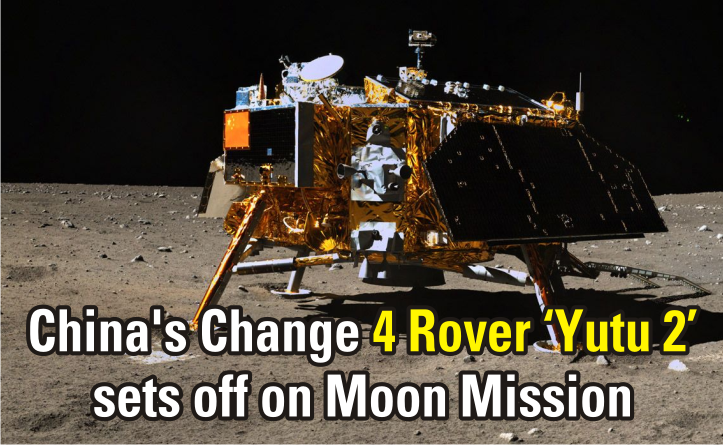
Chang’e-4, Chinese space probe named after the Chinese moon goddess, launched on 8 December 2018, made “soft landing” at the Von Kármán crater, the moon’s oldest and biggest impact crater in the South Pole-Aitken basin – a spot on the moon’s far side, which is untouched by earlier missions from earth, at 10.26 (02.26 GMT) on Thursday 3 January 2019 and transmitted first-ever “close range” image through communication relay satellite Queqiao, the China National Space Administration said. With this historic landing China joined a select group of countries with successful missions to the moon.
The rover – named Yutu 2, or Jade Rabbit 2 – left the spacecraft, drove off a ramp and began making tracks on the moon’s surface at 10.22pm on Thursday, about 12 hours after Chang’e 4 landed. Lunar project Chief Designer Wu Weiren called the separation of the rover “a small step for the rover, but one giant leap for the Chinese nation.”
Chang’e-4 landing “lifted the mysterious veil” of the far side of the moon and “opened a new chapter in human lunar exploration,” the China National Space Administration said in a statement on its website, which included a wide-angle colour picture of a crater from the moon’s surface. “It’s an important milestone for China’s space exploration, Wu Weiren, said.
Queqiao satellite, designed to allow radio communication between the far side of the moon and Earth without it being blocked by the near hemisphere, was launched last May by China for the very purpose of helping Chang’e-4 communicate with earth, as a direct communication with it is not possible from the moon’s far side, which never faces earth.
- Chang’e-4 Lunar probe has a lander and a rover.
- Chang’e-4 mission carries payloads, of which two are in collaboration with Germany and Sweden, respectively.
- Instruments include cameras, low-frequency radio spectrum analyser, lunar neutron and radiation dose detectors, and many more.
- Mission could pave the way to setting up a radio telescope on the far side of the moon, among other things.
- Chang’e-4’s tasks include astronomical observation, surveying the moon’s terrain, land form and mineral make-up, and measuring the neutron radiation and neutral atoms to study the environment of its far side, which is seen as a uniquely attractive site for monitoring radio waves coming from deep space.
- Astronomers operating Earth-bound radio telescopes have to constantly grapple with electromagnetic interference from human activity: shortwave broadcasting, maritime communication, telephone, and television signals.
- The far side of the moon is shielded from such signals, making it far easier to pick up faint fingerprints left by the Big Bang.
- Chang’e-4 mission could use soil test and temperature measurements to reveal new clues to the cataclysmic collision that created the moon and uncover the origins of the water that is unexpectedly abundant in lunar soil.
- The craft also carried a canister filled with air, soil, water, bacterium, silkworm eggs, cotton, rapeseed, potato, fruit fly and yeast, and a small plant called Arabidopsis which is expected to produce the first flower on the moon.
- Scientists hope that the small ecosystem will spring to life and produce the first blossoming flowers on the moon in about three months’ time.
The moon’s far side is sometimes known as the dark side, although it is not darker than the near side in any literal sense. It undergoes the same phases of illumination by the Sun as the side facing Earth. But because the moon spins on its axis at exactly the same rate as it orbits Earth, one side remains permanently out of view.
It was only in 1959, when the first images of the far side were beamed back by the Soviet Union’s Luna 3, that intriguing differences were revealed. The far side is pockmarked by more craters and appears almost devoid of the seas of solidified lava, known as Maria, that form the shadowy shape of a face that we see from Earth.
Related Articles
-
 Jan 19, 2017 10:44 am





Related Articles
-

Created at: May 29, 2019
-

Created at: May 28, 2019
-

Created at: May 27, 2019
-

Created at: May 27, 2019
-

Created at: May 26, 2019
-
Created at: May 26, 2019
-

Created at: May 25, 2019