
Social Media
Common Aspirations and Potential of India & China
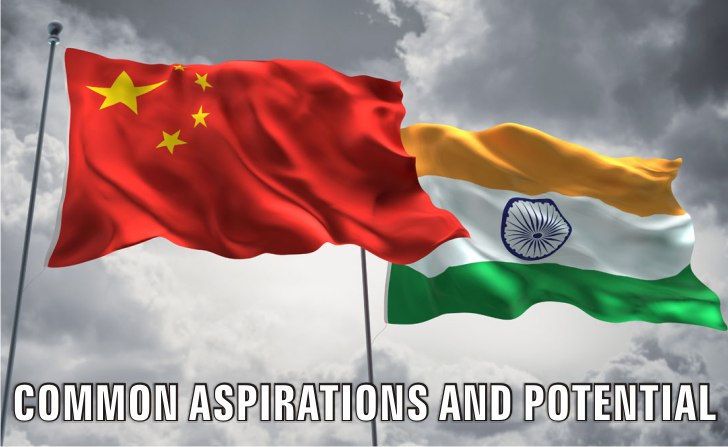
India and China are on the same road of globalization, with interests that could collide over issues such as access to markets, natural resources or strategic partners. Both are populous Asian nations experiencing high rates of economic growth with more exposure to international market forces. The two countries have reconciled to be on a path to perpetual cooperation during the fruitful talks on bilateral relations between Indian Prime Minister Narenda Modi and Chinese President Xi Jinping meeting on September 5, 2017 on the side-lines of BRICS Summit in Xiamen city of China that led to reconciliation, after the Doklam standoff. Surface similarities of these two emerging economies of India & China, both juggling globalization, conceal potential conflict and are likely to become rivals. Currently China dominates in manufacturing, while India dominates the service sector but both countries plan to compete in industries pioneered by the other. China seeks to move further into services and India into manufacturing.
China seems to desire that India remain a regional power that can be contained. For its part, India has greater aspirations, especially as its companies enjoy a period of global expansion. The two nations loom large in the geopolitics of Asia. China has a close relationship with Pakistan, assisting in the development of that country’s nuclear program, and building influence in Burma/Myanmar. Myanmar was included as an Indian province by the British. However, in 1937, it was recognised as a separate country. Since Independence bilateral relationship between India and Myanmar have stood the test of time. PM Modi recently visited Myanmar for 3 days starting 5 September 2017 to discuss security and counter-terrorism, trade and investment, and infrastructure and energy; and to strengthen cooperation between the two countries.
The aspirations of the India & China portend a future of growing rivalry, in which both countries will seek to advance their national interests generally by offering market and capital, and through the projection of soft power, but with military power in the background. However, the above meeting sent a critical message of reconciliation and cooperation to the world in a timely manner. Both leaders agreed to start a new chapter. An important consensus has been reached to enhance mutual trust, focus on cooperation, and manage differences. The common aspirations and potential of the two countries for cooperation and development are based on the following aspects:
- Economic and trade cooperation are gaining momentum. Last year, the trade volume between China and India exceeded $70 billion. China has been for many years the largest trading partner of India. More than 500 Chinese companies have invested and started business in India with a total investment of over $5 billion.
- Many Indian enterprises of IT, pharmacy and consultancy have entered the Chinese market. For instance, there are more than a hundred Indian software engineers living in the Sino-India Software Industry Park in Linyi city, Shandong province.
- People-to-people exchanges are thriving. Mutual visits between two countries have exceeded one million. Practising yoga, drinking Darjeeling black tea, and watching Bollywood movies have become fashionable among the Chinese youth. Yunnan Minzu University has established the India-China Yoga College. They are also working to hold the Annual Indian Tourism Conference in Yunnan province.
- Local exchanges are booming. China and India have established 14 pairs of sister cities and provinces. PM Modi made frequent visits to Guangdong province when he was the Chief Minister of Gujarat.
- Two countries have maintained close high-level communications. Home town diplomacy initiated by President Xi and PM Modi has become a much-told story. Both leaders have met more than a dozen times on bilateral and multilateral occasions.
- Now, China’s economy is stable and its reform has entered a crucial stage.
- India is also accelerating its reform. Make in India, Digital India, Start-up India and other initiatives have yielded outcomes. Significant measures like the GST Act have been implemented. Faced with similar development objectives and common challenges such as “anti-globalisation” and trade protectionism, China and India should work together.
- China and India should work towards the same direction and jointly implement the Xiamen consensus reached by the leaders. Both should work towards a sound and healthy bilateral relationship by focussing on cooperation, narrowing and resolving differences.
- Both sides should appropriately manage differences, get under control the problems left over by history such as issues related to boundary and the Dalai Lama, while finding solutions to new problems.
Sino-Indian relations started to thaw in 2000, gaining greater momentum with the visits of top officials from both countries, including Prime Minister Atal Bihari Vajpaypee’s 2003 travel to Beijing. In 2004, trade between the two countries topped $10 billion for the first time, and in 2006, Nathula, an ancient trade route that was part of the historic Silk Road, reopened for the first time since the 1962 Sino-Indian War.
Determining which approach, India’s or China’s, has been more successful in improving people’s lives and managing the process of globalization depends on the set of factors: economic growth, poverty reduction, political stability, business expansion, and conflict or compromise. In China, the high rates of economic growth have led to substantial decreases in poverty rates while, in India, poverty reduction has been more modest, the number of extreme poor remained roughly constant.
Related Articles
-
 Jun 18, 2017 15:36 pm




Related Articles
-

Created at: Nov 2, 2019
-

Created at: May 29, 2019
-

Created at: May 28, 2019
-

Created at: May 27, 2019
-
Created at: May 27, 2019
-

Created at: May 26, 2019
-
Created at: May 26, 2019