
Social Media
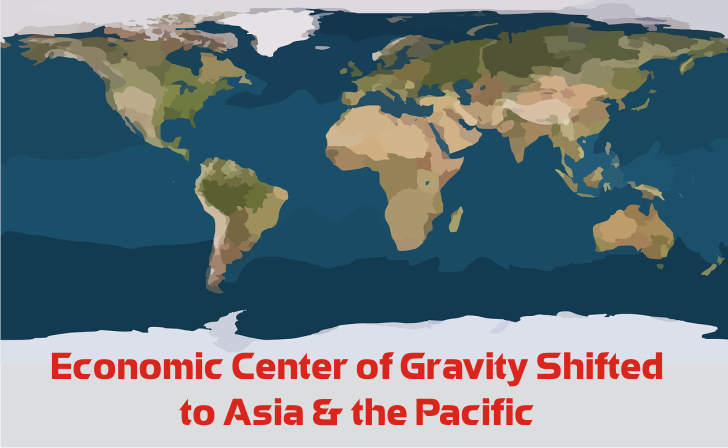
Economic Center of Gravity Shifted to Asia & the Pacific
Strategy 2030, Asian Development Bank (ADB)’s new long-term corporate strategy to 2030 for expanding its vision to achieve a prosperous, inclusive, resilient, and sustainable Asia and the Pacific, aims to set the course for ADB’s efforts to respond effectively to the region’s changing needs. ADB has been a key partner in the significant transformation of Asia and the Pacific that has made great strides in poverty reduction and economic growth in the past 50 years and aspires to make even greater leaps going forward. Takehiko Nakao, President ADB in his opening address at ADB’s 51st annual meeting held at Manila in Philippines during May 3 to 6, 2018 committed to reinventing the bank, to meet the challenges of a transforming Asia under its Strategy 2030, which will renew its commitment to eradicate poverty in the Asia and the Pacific (APAC) region.
There has been a shift of economic center of gravity to APAC region, which refers to the 48 economies of Asia and the Pacific that are members of ADB (ADB has 67 member countries, including these 48 from APAC). Australia, Japan, and New Zealand among them are referred to as Developed Member Economies and the remaining 45 Developing Member Economies are collectively referred to as Developing Asia. According to Nakao, “almost all our developing member countries have advanced to middle-income status. Yet, large challenges remain, and new ones are emerging”.
- APAC’s share of global gross domestic product increased from 25% in 2000 to 33% in 2016.
- Region is expected to account for more than half of global production by 2050.
- India and the People’s Republic of China (PRC) are now among the world’s largest economies.
- Associations of South East Asian Nations (ASEAN) countries, with a collective population of close to 640 million, have become important market-oriented emerging economies.
- Robust growth has resulted in a dramatic reduction in income poverty and improvements in standards of living.
- Extreme poverty, as measured by the $1.90/day threshold at 2011 purchasing power parity, significantly declined in developing Asia from 53% in 1990 to about 9% of the total population in 2013.
- Poverty still persists despite these positive trends that are expected to continue.
- Rise in equality, growing environmental pressures, and rapid urbanization must be addressed
- Aging in some countries and an increasing youth population in others present opportunities as well as challenges.
- Region also faces a dynamic and increasingly complex development landscape brought about by global events and emerging regional challenges.
Strategy 2030, Asian Development Bank (ADB)’s new long-term corporate strategy to 2030 for expanding its vision to achieve a prosperous, inclusive, resilient, and sustainable Asia and the Pacific, aims to set the course for ADB’s efforts to respond effectively to the region’s changing needs. ADB has been a key partner in the significant transformation of Asia and the Pacific that has made great strides in poverty reduction and economic growth in the past 50 years and aspires to make even greater leaps going forward. Takehiko Nakao, President ADB in his opening address at ADB’s 51st annual meeting held at Manila in Philippines during May 3 to 6, 2018 committed to reinventing the bank, to meet the challenges of a transforming Asia under its Strategy 2030, which will renew its commitment to eradicate poverty in the Asia and the Pacific (APAC) region.
There has been a shift of economic center of gravity to APAC region, which refers to the 48 economies of Asia and the Pacific that are members of ADB (ADB has 67 member countries, including these 48 from APAC). Australia, Japan, and New Zealand among them are referred to as Developed Member Economies and the remaining 45 Developing Member Economies are collectively referred to as Developing Asia. According to Nakao, “almost all our developing member countries have advanced to middle-income status. Yet, large challenges remain, and new ones are emerging”.
- APAC’s share of global gross domestic product increased from 25% in 2000 to 33% in 2016.
- Region is expected to account for more than half of global production by 2050.
- India and the People’s Republic of China (PRC) are now among the world’s largest economies.
- Associations of South East Asian Nations (ASEAN) countries, with a collective population of close to 640 million, have become important market-oriented emerging economies.
- Robust growth has resulted in a dramatic reduction in income poverty and improvements in standards of living.
- Extreme poverty, as measured by the $1.90/day threshold at 2011 purchasing power parity, significantly declined in developing Asia from 53% in 1990 to about 9% of the total population in 2013.
- Poverty still persists despite these positive trends that are expected to continue.
- Rise in equality, growing environmental pressures, and rapid urbanization must be addressed
- Aging in some countries and an increasing youth population in others present opportunities as well as challenges.
- Region also faces a dynamic and increasingly complex development landscape brought about by global events and emerging regional challenges.
S.C. Garg Secretary, Department of Economic Affairs (DEA), made the intervention on behalf of India in the Plenary Session of the 51st Annual Meeting of ADB and welcomed ADB’s Strategy 2030. In his intervention, highlighted the need for taking into account the likely impacts of the technical advancements that are taking place owing to Artificial Intelligence, robotics, etc. so that ADB can equip the member countries to reap maximum benefits out of these technical advancements. He further stated that the Strategy should focus more on West Asia and South Asia as interventions in East Asia are already done fairly well. He emphasized that the private sector operations of ADB as envisaged in the strategy should be enhanced. During the Business Session, Garg applauded ADB for focusing on poverty eradication, quality jobs and increased support for social sectors while reiterating its commitment to building the infrastructure.
Related Articles
-
 Apr 26, 2017 11:39 am







Related Articles
-

Created at: Nov 2, 2019
-

Created at: May 29, 2019
-

Created at: May 28, 2019
-

Created at: May 27, 2019
-

Created at: May 27, 2019
-

Created at: May 26, 2019
-
Created at: May 26, 2019