
Social Media
Important Facts Related to Indian Economy: – (Industry)
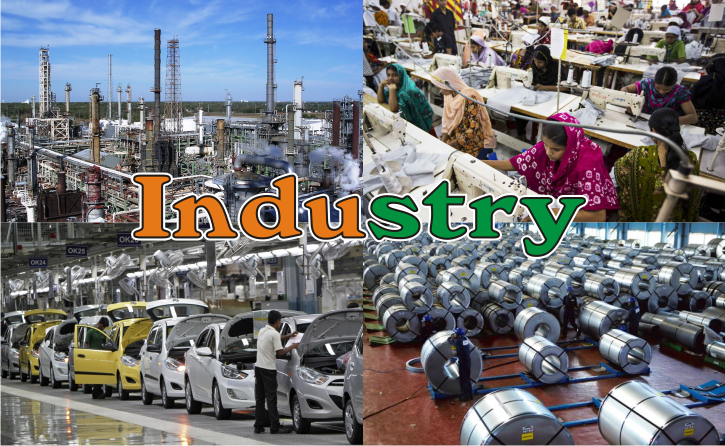
- Planwise Industrial Growth rates :
Ninth Plan (1997-2002) 4·3%
Tenth Plan (2002–07) 9·4%
Eleventh Plan (2007–12) 7·2%
Twelfth Plan (2012–17)
(Target) 7·6%
- Planwise Manufacturing Sector Growth Rates :
Ninth Plan (1997–2002) 3·3%
Tenth Plan (2002–07) 9·3%
Eleventh Plan (2007–12) 7·7%
Twelfth Plan (2012–17)
(Target) 7·1%
- During 2014-15, industrial sector registered growth of 5·9% which as per advanced estimates of 2015-16, became 7·4%. For 2016-17, it is estimated at 5·2%.
- India’s services sector remains the major driver of economic growth contributing 72.4 per cent of GDP growth in 2014-15. Services-sector growth has increased from 7·8 per cent in 2012-13 to 8·0 per cent in 2013-14 and further to 10.3 per cent in 2015-16. For 2016-17, it is estimated at 9 per cent.
- The services sector is also the dominant sector in most of the states of India with a more than 40 per cent share in the gross state domestic product (GSDP) for almost all states.
- Service sector has made substantial contribution to FDI inflows, exports, and employment.
|
Black Revolution |
|
After seeking self-dependence in foodgrains and milk production through ‘Green Revolution’ and ‘White Revolution’ respectively, the govern-ment is now planning for ‘Black Revolution’ for making the country self-dependent in petroleum/crude oil. For ensuring success in this direction, the government plans to accelerate the production of Ethnol and to mix it upto 10% in petrol and also to accelerate production of bio diesel. |
- As per the first revised estimates of real gross value added (GVA) released by CSO for the year 2014-15 i.e., GVA at constant (2011-12) basic prices, service sector growth accelerated to 10·3% from 7·8% in the previous year, but it declined to 9·0% in 2016-17.
- The rate of growth of gross capital formation in dustry has registered a sharp rise from (–) 3·7% in 2013-14 to 3·6% in 2014-15, showing upward momentum of investment in the industry.
- Growth in credit flow to industrial sector, including mining and manufacturing has slowed down in 2015-16 as compared to 2014-15.
- During 2015-16, credit to micro and small industries and large industries grew at 2·5% and 6·6% respectively but credit flow to medium scale industries declined by 7·6% during the same period.
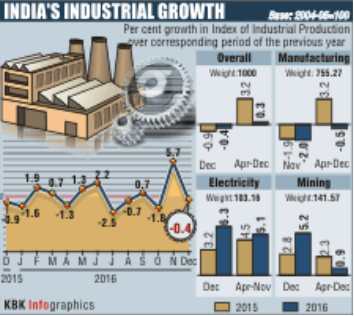
- As per the first advance estimates of the CSO, growth rate of the industrial sector comprising mining & quarrying, manufacturing, electricity and construction is projected to decline from 7.4 per cent in 2015-16 to 5.2 per cent in 2016-17 .
- During April-November 2016-17, a modest growth of 0.4 per cent has been observed in the Index of Industrial Production (IIP) which is a volume index with base year of 2004-05.
- In terms of use-based classification, basic goods, intermediate goods and consumer durable goods attained moderate growth. Conversely, the production of capital goods declined steeply and consumer non-durable goods sectors suffered a modest con-traction during April November 2016-17.
- The eight core infrastructure supportive industries, viz. coal, crude oil, natural gas, refinery products, fertilizers, steel, cement and electricity that have a total weight of nearly 38 per cent in the IIP registered a cumulative growth of 4.9 per cent during April-November 2016-17 as compared to 2.5 per cent during April-November 2015-16.
- The production of refinery pro-ducts, fertilizers, steel, electricity and cement increased substantially, while the production of crude oil and natural gas fell during April-November 2016-17.
- Coal production attained lower growth during the same period.
- Most indicators of infrastructure-related activities showed expansion during H1 2016-17. Thermal power with a growth of 6.9 per cent boosted overall power gene-ration while hydro and nuclear power generation contracted marginally during April-September 2016 .
- The Government has liberalized and simplified the Foreign Direct Investment (FDI) policy in sec-tors like defence, railway infra-structure, construction and pharmaceuticals, etc. During April-December 2016-17, FDI equity inflows were US$ 35.844 billion as compared to total FDI inflows of US$ 40 billion during April-March 2015-16.
- Sectors like services sector, construction development, computer software & hardware and telecommunications have attracted highest FDI equity inflows.
- Total FDI inflow into India during 2015-16 was US $ 55·457 bn which was a record. During 2014-15 FDI inflow was US $ 45·148 bn. Investment by FIIs during 2015-16 went negative with an outflow of US $ 3·516 bn. as compared to inflow of US $ 40·923 bn. in 2014-15.
- Foreign Investment Promotion Board abolished since April 1, 2017. FDI proposals beyond automatic route had to be approved by FIPB.
- With 3·6 crore units spread across the country, that employ 8·05 crore people, MSME sector has contributed 37·5% to the country’s GDP.
- Among MSME sector, 94·94% enterprises are micro enterprises, 4·89% small enterprises and 0·17% medium enterprises.
- Among MSME sector, 45% enterprises are in rural sector and 55% are in urban sector. 67·17% enterprises belong to manufacturing sector and 16·78% to service sector.
- MSME sector contributes 45% in manufacturing sector production and 40% in exports of the country.
- The performance of the coal sec-tor in the first two years of the Twelfth Plan has been subdued with domestic production at 556 MT in 2012-13 and 639·23 MT in
- India accounts for 1·8% of the worlds manufacturing output.
- New industrial policy 1991 was declared on July 24, 1991. It was a first major policy document under the policy framework of Liberalisation, Privatisation and Globalisation.
- A separate Industrial Policy for small scale industries sector was declared on 6th August, 1991 for the first time.
- SSI investment limit (in plant and machinery) of hosiery, hand tools, stationery and drugs and pharmaceuticals has been enhan-ced from 1 crore to 5 crore to enable technology upgradation modernisation and to meet the present day global requirements.
- The small units having investment upto 25 lakh in plants and machinery are called tiny units.
- Under the provisions of new Industrial Policy, export-oriented industrial units will get automatic sanction of Foreign Equity Investment up to 51%.
- For making Foreign Capital Investment more easier, Foreign Exchange Regulation Act, 1973-FERA—was liberalized on 8th January, 1993 by an ordinance issued by President of India. Now in December 1999 FERA has been replaced by FEMA (Foreign Exchange Management Act).
- India imports about 75% of its requirements of crude petroleum.
- Textile Industry is the largest industry in the country. The share of Textile Industry in total industrial production is about 20%. It also contributes 38% in total exports of the country. This industry provides employment to about 200 lakh people in the country. It is the second largest employment provider in the country.
|
Make in India Campaign
|
The basic philosophy behind the ‘Make in India’ campaign are :
|

Following new initiatives have been taken up by the Government to facilitate investment and ease of doing business in the country.
* Make-in-India,
* Invest India,
* Start Up India and
* e-biz Mission Mode Project under the National e-Governance Plan.
- Online application for Industrial Licence and Industrial Entrepreneur Memorandum through the e Biz website 24 ¥ 7 for entrepreneurs;
- Simplication of application forms for Industrial Licence and Indus-trial Entrepreneur Memoramdum.
- Textile sector is an export intensive sub sector and contributes about 40–45% to total textiles exports.
- Cotton Industry depends upon the supply of cotton. (i.e., white gold). India holds fourth place in the world in cotton production.
- As far as cotton producing area is concerned, India holds first place in the world. 40% of total cotton production is consumed by mills in the public sector. Maharashtra is the largest cotton producing area in the country.
- The leather Industry occupies a prominent place in the Indian economy in view of its substantial export earnings, employment potential and growth. The small-scale, cottage and artisan sector account for over 75 per cent of the leather production.
|
India Inclusive Innovation Fund |
|
The National Innovation Council and the Ministry of Micro, Small and Medium Enterprises (MSME) have jointly announced the creation of the India Inclusive Innovation Fund (IIIF). Approved by the Union Cabinet, the fund was conceived as a unique con-cept that seeks to combine innovation and the dynamism of enterprise to solve the problems of citizens at the base of the economic pyramid in India. |
The leather sector provides employment mainly to people from the disadvantaged sections of society. More than 30 per cent of the work force employed in this sector constitute women.
- India has emerged as one of the key players in the gems and jewellery sector on account of its traditional strength in craftsmanship and its reasonable share in global business.
- There were 298 central Public Sector Enterprises (CPSEs) as on March 31, 2015. Of these, 235 were operational and 63 under construction.
- The financial investment (Paid-up capital + long term loans) in all the CPSEs stood at 10,96,057 crore as on March 31, 2015, showing an increase of 10·5% over 2013-14.
|
Small and Medium Enterprise Development Bill, 2005 (which was introduced in the Parliament on May 12, 2005) has been approved by the President and thus became an Act. This new Act, named as ‘Small and Medium Enterprise Development Act, 2006, has become effective from Oct. 2, 2006. This Act makes a different category for medium level enterprises. According to this Act, the investment limit for tiny industrial units will be 25 lakh while the investment limit for small industrial units has been enhanced to 5 crore. As per the new Act, new category of medium enterprises will have investment between 5 crore to 10 crore. For service sector units, having investments upto 10 lakh, 2 crore and 5 crore will be categorised as tiny unit, small unit and medium enterprise respectively. |
The net profit of 157 profit making CPSEs stood at 1,30,363 crore in 2014-15 while the net loss of loss-making 77 CPSEs stood at 27,360 crore.
India ranked at the fourth largest producer of crude steel in the world during 2013 after China, Japan and the USA.
SIDBI setup the India Micro finance Equity Fund in 2011-12 with budgetary support of 100 crore.
The Technology up gradation Fund Scheme (TUFS) and Schemes for Integrated Textile Parks (SITP) are two flagship schemes of the Ministry of Textiles. Government of India’s investment target in Technology Upgradation Fund Scheme for the textile sector in the 12th plan is 1,51,000 crore. 2,400 crore has been allotted into this fund in the Union Budget 2013-14.
- sfurti (Scheme of Fund for Regeneration of Traditional Industries) was started during the Eleventh Plan for the development of Khadi, Village industries and coir. The 12th plan has provided an outlay of 850 crore to SFURTI.
|
Govt. Scraps MSME Exclusive Items List |
The government has done away with the final list of items, ranging from pickles to firecrackers, which were reserved only for the MSME (micro, small and medium enterprises) sector for manufacturing. This has been done to boost investment and technological advancement. With this move, the government has dereserved all items.The move was taken “to encourage greater investment, including the existing MSME units, to incorporate better technologies, standard and branch building to enhance competition in Indian and global markets for these products.” The government has been reducing the number of items in the list progressively since 1991. Over the years, the list was reduced from 800 items to 20 at present.Besides allowing large scale manufacturing, the move will also allow import of pickles, mustard oil, groundnut oil, wooden furniture, fire works, glass bangles, safety matches, steel chairs, rolling shutters, wax candles and laundry soaps among others. |
- Board for Industrial and Financial Reconstruction (BIFR) was established under Sick Indus-trial Companies Act, 1985. The Board started its functioning w.e.f. May 15, 1987.
- The process of disinvestment in the Public Sector Undertakings was started since 1991-92.
- To minimize the financial burden on the Public Sector Enterprises the Government has started Voluntary Retirement Scheme for the employees by giving full compensation to employees. This is called ‘Golden Hand Shake Scheme’.
- To evaluate the problems of finance and sickness of small industries, the Govt. had constituted Nayak Committee which submitted its report in September 1992.
- At present only 2 industries have been reserved for the Public Sector—
(i) Atomic Energy.
(ii) Rail Transport.
[Recently a decision has been taken to open defence industry sector to private sector with foreign direct investment permissible upto 49%]
- At present only 4 industries are required to obtain compulsory license—
(i) Cigars, cigarettes and other substitutes of prepared tobacco.
(ii) Electric, Aerospace and all types of defence equipment.
(iii) Industrial explosives including detonating fuses, safety fuses, gunpowder, nitrocellulose, and matches;
(iv) Specified hazardous chemicals—
(a) Hydocyanic acid and its derivatives;
(b) Phosgene and its derivatives;
(c) Isocyanates and dissociates of hydrocarbon not elsewhere specified are still under compulsory licensing.
- Petroleum and Natural Gas Regulatory Act, 2006 has been notified on April 3, 2006 to regulate specific activities relating to petroleum, petroleum products and natural gas consequent to deregulation of the petroleum sector.
- The government had completely delicensed the paper industry from July 17, 1997. Foreign direct investment (FDI) upto 100% is permitted on automatic route in paper industry.
- Sugar industry has been partially deregulated on April 4, 2013. The cabinet committee on Economic Affairs abolished the sugar levy an sugar mills and deregulated sale of sugar in the open market.
RBI Notifies Hike in FDI Cap in Insurance Sector—The Reserve Bank of India (RBI) has notified the government’s decision to raise Foreign Direct Investment (FDI) limit in the insurance sector to 40 per cent from 26 per cent.
- According to World Investment Report 2016, USA stood top in FDI inflow during 2015 with $ 380 billion followed by Hong Kong and China. USA also remained at the top in FDI outflow during 2015 with $ 300 billion.
- According to World Investment Report 2016, FDI inflow in India during 2015 stood at $ 44·2 billion which is 27·7% more as compared with $ 34·6 billion level of 2014.
- In the world list of top countries having maximum FDI inflow, India’s rank was 9th in 2014 which slipped down to 10th rank in 2015.
- 49% FDI in credit information companies has been allowed.
- FDI upto 100% under the automatic route has been allowed both in setting up and in established industrial parks.
- GoI allowed 51% FDI in multi-brand retail sector with the fol-lowing two riders—
(i) Foreign retailing company will have to compulsorily source one third of the products they sell from small and medium enter-prises whose investments do not exceed $ 1 million in total.
(ii) Foreign retailing company will have to invest at least $ 100 million, half of which has to go into backed infra-structure over three years.
- FDI policy in the petroleum and natural gas sector has been rationalised.
- As on March 31, 2017 there are 7 ‘Maharatna’ public sector enterpris SAIL, ONGC, IOC, NTPC, CIL, BHEL and GAIL.
- GOI has granted Navratna status to container corporation of India, increasing their number to 17.
- Government has granted ‘Mini Ratna’ status to three PSUs. These units are—IRCTC (Indian Railways Cattering and Tourism Corporation), Satluz Hydro Power Corporation and National Hydro Power Corporation.
- Small industries account for 45% of total industrial production and 40% of total exports of the country.
- Small Industries Development Organization (SIDO) was established in 1954.
- As far as licensing is concerned, the sector of Small Industries has been completely deregulated.
- First ever factory to build Diesel Engine was established in Satara-Maharashtra in 1932.
- The first cycle making factory of India was established in Calcutta in 1932. India holds second place in the field of cycles production in the world. About 90 lakh cycles are produced annually in India.
- National Awards for scheduled commercial banks were constituted by the Ministry of SSI for best performance in terms of lending to SSIs.
- Petrol and diesel prices were deregulated from April 1, 2002. But administered pricing regime made a backdoor entry in 2004 with UPA government pushed for control on diesel, LPG and kerosene price.
- Union Cabinet deregulated diesel prices. Now the diesel price moves as per market conditions since October 19, 2014.
- LPG and Kerosene prices are still under Administered Price Mechanism.
|
New Exploration Licencing Policy-X |
| The Union Government has unveiled the blocks of its 10th round of oil and gas exploration auction. In this round of auction, at least 46 blocks, covering 166053 sq. km, will be offered for domestic and foreign investors. This 10th round of the New Exploration Licencing Policy (NELP-X) would be the second highest after NELP-VI in which 52 blocks were offered. These 10th round of offer will now be across 13 basins. The largest number during this round would be from the Cambay basin (nine), followed by Mumbai (seven) and Andman (five).
So far, 128 hydrocarbon discoveries have been made in 42 NELP blocks. Upto the past nine rounds of NELP, an investment worth $ 21.3 billion (i.e. 1.3 lakh crore) have been made. In the pre NELP regime, a total of 35 exploration and production companies (5 state owned, 15 private and 15 foreign companies) had participated. After nine rounds of NELP, the number of companies has increased to 117 including 11 state owned companies, 58 private Indian companies and 48 foreign ones. |
- The government has already deregulated the import and pricing of Aviation Turbine Fuel (ATF) from April 1, 2001.
- Handicraft sector provides employment to 65 lakhs artisans.
- India is the world leader in carpet exports with 36% of the global market share.
- The woollen textiles industry is a rural based, export-oriented industry in which the organised sector, the decentralised sector, and the rural sector complement each other. This industry provides employment to 27 lakh workers in a wide spectrum of activities. The country is the seventh largest producer of wool in the world.
Related Articles
-
 Feb 07, 2019 11:00 am


Related Articles
-

Created at: May 28, 2019
-

Created at: May 27, 2019
-

Created at: May 26, 2019
-

Created at: May 24, 2019
-
Created at: May 24, 2019
-
Created at: May 14, 2019
-

Created at: May 13, 2019