
Social Media
Justice P C Ghose is India’s First Lokpal
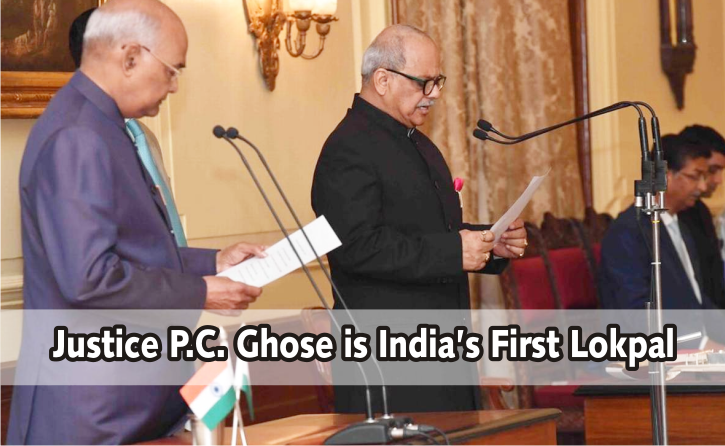
India gets its first Lokpal, as the former Supreme Court Judge Pinaki Chandra Ghose has been appointed as Lokpal, an office dedicated to fighting systemic corruption in the country, by a committee consisting of Prime Minister Narendra Modi, Chief Justice of India Ranjan Gogoi, Loksabha Speaker Sumitra Mahajan and Senior Advocate Mukul Rohatgi in the capacity of ’eminent person’. The concept of an institutional mechanism, or an anti-corruption ombudsman, which has been around for over 50 years, finally got shape with the passing of the Lokpal and Lokayuktas Bill – 2013, in Lok Sabha on 18 December 2013. It was finally enacted as a law in 2013, and came into effect on January 16, 2014.
President Ram Nath Kovind has appointed Justice Pinaki Chandra Ghose as Lokpal along with other members of the anti-corruption watchdog, according to a communiqué issued by Rashtrapati Bhavan on 20 March 2019. 66-year old Justice Ghose retired as Supreme Court judge in May, 2017. He is a member of the National Human Rights Commission since 29 June 2017.
President of India administered the Oath of Office to Shri Justice Pinaki Chandra Ghose as Chairperson, Lokpal, at a ceremony held on Saturday 23 March 2019 at 1030 hrs at Rashtrapati Bhavan.
Lokpal will have four judicial and four non-judicial members. Former Chief Justices – Dilip B. Bhosale, Pradip Kumar Mohanty, and Abhilasha Kumari and sitting Chief Justice of Chhattisgarh High Court Ajay Kumar Tripathi – have been appointed as judicial members.
Non-judicial members are: former first woman Chief of Sashastra Seema Bal Archana Ramasundaram, ex-Maharashtra Chief Secretary Dinesh Kumar Jain, former IRS officer Mahender Singh and ex-IAS officer Indrajeet Prasad Gautam.
Lokpal Act was passed in 2013 following a nationwide anti-corruption movement led by India Against Corruption, a civil society movement of activist Anna Hazare in 2011 against what many saw as unreasonable levels of corruption under the then UPA regime, spurred by Hazare’s hunger strike, which demanded the appointment of Lokpal at the Centre and Lokayuktas in the states to probe and prosecute corruption complaints against political leaders and public servants, including the Prime Minister and Chief Ministers.
- Constitutional Ombudsman as a concept was for the first time proposed in parliament by Law Minister Ashoke Kumar Sen in early 1960s.
- Dr L M Singhvi coined the term “Lokpal” in 1963.
- 1st Administrative Reforms Commission in 1966 recommended enacting of the Office of a Lokpal so as to remove the sense of injustice from the minds of citizens and to instil public confidence in the efficiency of the administrative machinery.
- Eight attempts were made from 1968 to 2011 to pass Lokpal Bill, but in vain.
- A group of Ministers, chaired by Pranab Mukherjee, was formed by the government in 2011to examine proposal of a Lokpal Bill and suggest measures to tackle corruption
- Lokpal and Lokayuktas Bill passed in both Houses of Parliament in 2013.
- Lok Sabha agreed on a couple of amendments in 2016 on the declaration of assets by public servants and Bill was sent to Standing Committee for review.
- Lokpal Act allows setting up of anti-corruption ombudsman called Lokpal at the Centre and Lokayukta at the State-level.
- Lokpal will consist of a chairperson and a maximum of eight members.
- Lokpal will cover all categories of public servants, including the Prime Minister.
- Armed forces do not come under the ambit of Lokpal.
- Act also incorporates provisions for attachment and confiscation of property acquired by corrupt means, even while the prosecution is pending.
- States to institute Lokayukta within one year of the commencement of the Act.
- Lokpal will have the power of superintendence and direction over any investigation agency including CBI for cases referred to them by the ombudsman.
- Lokpal can summon or question any public servant if there is any prima facie case against the person, even before an investigation agency (such as vigilance or CBI) has begun the probe.
- Any officer of the CBI investigating a case referred to it by the Lokpal, shall not be transferred without the approval of the Lokpal.
- An investigation must be completed within six months.
- Lokpal or Lokayukta may, however, allow extensions of six months at a time provided the reasons for the need of such extensions are given in writing.
- Special courts will be instituted to conduct trials on cases referred by Lokpal.
- Lokpal can award fine up to ₹2 lakh for “false, frivolous or vexatious” complaints.
Lokpal’s appointment system is a two-stage process. A search committee has to be formed. It recommends a panel of names to the high-power selection committee, which comprises Prime Minister, Speaker of Lok Sabha, Leader of the Opposition, Chief Justice of India (or his nominee) and an eminent jurist. The selection panel has to choose from a short-list consisting of names for the posts of Lokpal chairperson, and judicial and non-judicial members.
The 16th Lok Sabha that commenced May 2014 does not have a Leader of Opposition to sit on the selection panel. For an opposition party to get the Leader of the Opposition post it should have strength of at least 10% of the total members in the House and none of the parties managed to cross this mark. The Congress (largest opposition party) leader in the Lok Sabha, Mallikarjun Kharge, did not attend selection committee meetings as a ‘special invitee’ and wanted full membership.
Now that the Lokpal has been chosen, victims of corruption have a viable avenue of redress. Lokpal will take over the work of sanctioning prosecution, besides exercising its power to order preliminary inquiries and full-fledged investigations by any agency, including the CBI.
Tags: first lokpal, first lokpal Ombudsman, former Supreme Court Judge Pinaki Chandra Ghose, Justice P C Ghose first Lokpal, Justice P C Ghose is India’s First Lokpal
Related Articles
-
 Jun 18, 2017 16:02 pm






Related Articles
-
Created at: Jan 22, 2020
-

Created at: May 29, 2019
-

Created at: May 28, 2019
-

Created at: May 28, 2019
-

Created at: May 27, 2019
-
Created at: May 27, 2019
-

Created at: May 26, 2019