
Social Media
Stephen Hawking had a Razor-Sharp Mind Inside the Shell of his Increasingly Useless Body
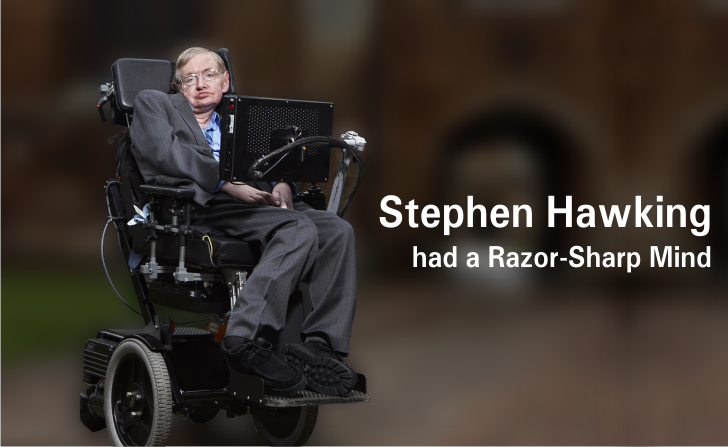
Stephen Hawking, famed for his work on black holes and relativity, was Britain’s most famous modern day scientist, a genius who dedicated his life to unlocking the secrets of the Universe. Hawking was born on January 8, 1942, became disabled at 21 – in 1963 diagnosed with Amyotrophic Lateral Sclerosis (ALS) – an incurable motor neurone disease, and was given two years to live. He survived this till March 14, 2018 – died at the age of 76, and during the period Hawking excelled in the manner he did. Inside the shell of his increasingly useless body was a razor-sharp mind, fascinated by the nature of the Universe, how it was formed and how it might end. He went on to Cambridge to become a brilliant researcher and Professorial Fellow at Gonville and Caius College and held the post of Lucasian Professor at Cambridge from 1979 to 2009, the chair held by Isaac Newton in 1663.
- Stephen Hawking was regarded as one of the most brilliant theoretical physicists since Einstein, a cosmologist and an author,
- Hawking believed science was his destiny and his work centred on bringing together relativity and quantum theory.
- Professor Hawking had over a dozen honorary degrees and was awarded the CBE in 1982, Wolf Foundation prize (1988), Companion of Honour (1989). Copley Medal (2006), Presidential Medal of Freedom (2009) and Fundamental Physics prize (2013).
- He was a fellow of the Royal Society and a member of the US National Academy of Science.
- He published several popular science books such as A Brief History of Time in 1988, his best-selling book, describing in non-technical terms the structure, development and fate of the universe. It was followed in 2001 by The Universe in a Nutshell.
- Hawking’s scientific works included collaboration with Roger Penrose on Gravitational singularity theorems in the framework of General Relativity and the theoretical prediction that Black holes emit radiation, often called Hawking radiation.
- Hawking was the first to set out a theory of Cosmology explained by a union of the general theory of relativity and Quantum mechanics and was a vigorous supporter of the many-worlds interpretation of quantum mechanics.
Hawking had said, “I believe life on Earth is at an ever-increasing risk of being wiped out by a disaster such as sudden global warming, nuclear war, a genetically engineered virus or other dangers.”
He ranks with Isaac Newton and Albert Einstein as that rare physicist who fired the popular imagination. Hawking was focussed on cosmology and gravitation, while Newton and Einstein worked on broad canvases. Hawking’s was a life that carried to the public not only the secrets of the cosmos but also the promise of hope and human endeavour; he showed that disability need not hold a person back in the pursuit of his dreams. He leaves behind a wealth of knowledge, and also the conviction that the will to survive can overcome all odds. Hawking believed that Artificial Intelligence (AI) could contribute to the eradication of disease and poverty, while warning of its potential dangers.
Stephen Hawking visited India in January 2001 on being invited to attend ‘Strings 2001’ conference. This event brought together 300 researchers from around the world to discuss the origin of the universe, among other things. At Strings 2001, Hawking delivered several lectures, including one titled “The Universe in a Nutshell”, in which he traced the developments in cosmology through the years and even made his own predictions about the fate of the universe. He was felicitated with the first “Sarojini Damodaran Fellowship” during the “Strings 2001” conference, one of the three scientists to be awarded the first Sarojini Damodaran Fellowship by the Tata Institute of Fundamental Research in Mumbai. He also celebrated his 59th birthday on Jan. 08, 2001, at the Oberoi Towers hotel where he stayed. He also delivered the Albert Einstein Memorial Lecture, titled “Predicting the Future: from Astrology to Black Holes”, in New Delhi on Jan. 15, 2001; met the then president KR Narayanan at the Rashtrapati Bhavan and remarked that the country had changed dramatically since his last trip over 40 years ago in 1959
Related Articles
-
 Nov 22, 2017 05:00 am




Related Articles
-
Created at: Jan 22, 2020
-

Created at: May 29, 2019
-
Created at: May 28, 2019
-

Created at: May 28, 2019
-

Created at: May 27, 2019
-

Created at: May 27, 2019
-

Created at: May 26, 2019