
Social Media
Doklam Standoff a Setback for China
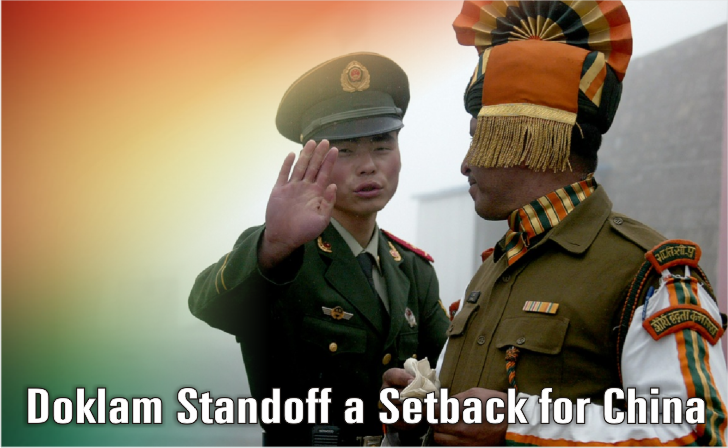
Doklam standoff was a deadlock between Indian and Chinese soldiers over the construction of a road by China in Dokalam region that overlooks the strategic Chumbi Valley, near the Bhutan trijunction, belongs to Bhutan and is strategically significant for India, adding tension to the Sino-Indian relation. Dokalam is the Bhutanese name of the region which is recognised by India as Doka La. Doka La is also India’s last military post on the trijunction of its boundary with Bhutan and China. China claims it as a part of its Donglang region. Bhutan has no diplomatic ties with China and is supported militarily and diplomatically by India. The standoff threatened to derail decades of trust-building between New Delhi and Beijing after the fallout of 1962 war.
- Dokalam standoff started on June 16, 2017 after China’s People’s Liberation Army moved a large earthmoving unit on to the Doklam plateau and started constructing a road towards Doka La.
- Bhutan had formally objected to China’s road construction in the disputed area.
- Royal Bhutan Army tried to intervene from Zompelri ridgee but they were pushed back.
- Bhutanese Army approached the Indian troops for help.
- Indian Army moved down the ridge and obstructed the construction work, leading to the standoff.
- India has officially accepted that its troops blocked PLA road construction inside Doklam as it would “represent a significant change of status quo with serious security implications for India.”
- Doklam standoff continued for 70 days during which the soldiers of Indian Army and the People’s Liberation Army of China held their positions in what India described as “no war, no peace” mode. The troops of the two countries stood at merely 150 metres from one another.
During the standoff, Chinese media had launched a propaganda war against India, threatening New Delhi with war even. However, India didn’t respond to China’s verbal attacks and, instead, insisted on finding a peaceful solution to the issue through dialogues. Unlike China India maintained utmost restraint with only two statements from MEA seeking to restore status quo at Doklam based on 2012 Sino-Indian agreement on trijunction besides statement from Foreign Minister Sushma Swaraj who emphasised on a solution through diplomatic means.
Small incursions and troop stand-offs are common along other parts of the contested 3,500 km border between India and Chinese soldiers. However, the recent standoff was marked by its length and the failure of talks to resolve the dispute, raising fears of a wider escalation as the two Asian giants compete for influence. The Nathu La Pass on the border between India’s Sikkim and China-controlled Tibet was the site of a fierce border clash between Chinese and Indian troops in 1967.
Doklam standoff, that had cast a shadow over bilateral ties has ended on Monday August 28, 2017; through mutual disengagement of each other’s troops from the region ahead of PM Narendra Modi’s visit to Xiamen for BRICS Summit between Sep 3-5, 2017; with a two-point statement by the Ministry of External Affairs titled “Doklam Disengagement Understanding” when India and China decided to disengage their soldiers in the Doklam region of Sikkim sector. In a statement, the MEA stated:
- “In recent weeks, India and China have maintained diplomatic communication in respect of the incident at Doklam. During these communications, we were able to express our views and convey our concerns and interests.
- On this basis, expeditious disengagement of border personnel at the face-off site at Doklam has been agreed to and is on-going.”
Media reports interpreted the decision taken by both countries as a victory of India’s diplomacy, which was praised by other international powers as well. While Japan had openly backed India, the US offered to help both countries in ending the standoff.
Doklam standoff signifies:
- India has shown that it cannot be bullied and pressurised by China in any way.
- Doklam standoff is a reminder for India that China will continue to needle it along the borders especially where Indian position is not so strong. Army Chief General Bipin Rawat has already said that the Indian forces should remain prepared to deal with an increase in Doklam like incidents.
- Doklam standoff sends a strong message to India’s neighbours that New Delhi can stand for them in the times of crisis. India can tell its other neighbours that there is no need to get bullied by China or succumb to Chinese military and economic pressure to the extent of compromising sovereignty. Sri Lanka and Bangladesh may rethink their Chinese policy and come out stronger in dealing with Beijing.
- Doklam standoff was a diplomatic setback for China as despite China’s attempt to garner international support over Doklam its diplomacy was no match to India’s in convincing the world leaders that the communist nation was at fault in the disputed region.
- US and the UK categorically asked China to resolve the matter diplomatically and bilaterally with India. The messages from the US and the UK came at a time when China was firm on its demand that Indian troops must withdraw from Doklam first.
- Japan was more upfront in saying that it was China which violated the international law at Doklam. Japan said that China tried to alter status quo at Doklam while suggesting that no country should try to change the existing positions without resolving the dispute.
- China’s effort to take Nepal along also did not yield desirable result stating that it would prefer neutrality to taking sides over Doklam standoff.
- Doklam standoff is also a learning experience for China. Beijing would know that violating an existing pact, bilateral or multi-lateral, with India may not be easy to get away with. China violated the 2012 understanding of maintaining status quo at Doklam and tried to pressurise India with repeated references to 1962-war. But, India stood firm and forced China to rethink its position.
- India was extremely concerned about Doklam passing into Chinese hands as this would have brought the northern big neighbour dangerously close to the Silliguri Corridor or India’s Chicken Neck – the only connect with the north-eastern states. India must look for ways to put in place more routes through Bangladesh to have efficient and safe connectivity with the seven sisters in the northeast.
In the view of Doklam standoff, the success of BRICS scheduled for September 3-5, 2017 at Xiamen in China was under question. There was also speculation about Prime Minister Narendra Modi skipping the summit. The theme of Xiamen BRICS summit was “Stronger Partnership for a Brighter Future”. But Doklam standoff could have embarrassed China as it was being seen as violator of international laws at the disputed site by attempting to alter the status quo without settling the boundary question with the countries concerned. China has given utmost importance to BRICS since its inception in 2009 projecting it as an alternate economic model against those dominated by the US and the western bloc.
Doklam deserves some introspection on the part of India. Beijing seems to have assumed a passive Indian response to its initial construction efforts. Possibly New Delhi’s failure to respond to the initial Chinese action of demolishing two vacant Indian bunkers was misread. Or Beijing concluded that India would feel constrained about interceding on behalf of the territorial claims of a third country. Either way, there was a miscalculation that was potentially dangerous. The announcement of a withdrawal indicates neither side is interested in a wider conflict. But there needs to be some thought about the growing regional footprints of both countries and that their spheres of influence will brush against each other in third countries with increasing frequency. India and China should not see Doklam in terms of point-scoring but rather as a warning of the need for extending their border management framework across other borders as well.
Related Articles
-
 Jul 14, 2018 12:00 pm





Related Articles
-
Created at: Jan 22, 2020
-

Created at: Nov 2, 2019
-

Created at: May 29, 2019
-

Created at: May 28, 2019
-

Created at: May 28, 2019
-

Created at: May 27, 2019
-
Created at: May 27, 2019