
Social Media
Eruption of Anak Krakatau Volcano triggered Indonesia tsunami
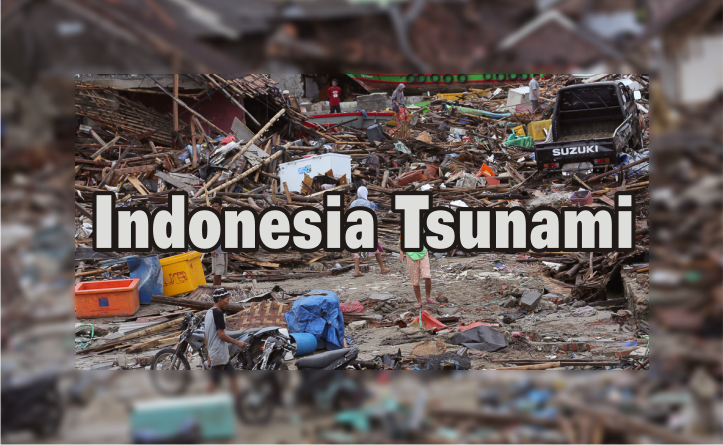
Anak Krakatau Volcano erupted in the Sunda Strait dividing Indonesian islands of Java and Sumatra just after 9 p.m. and triggered a deadly tsunami at around 9.30 p.m. on Saturday 22 December 2018. The tsunami was caused by “an undersea landslide resulting from volcanic activity on Anak Krakatau” and was exacerbated by abnormally high tide because of the full moon. The death toll climbed to 429 by Tuesday 25 December with search and rescue teams struggling to find survivors and bodies due to heavy rain. The most affected area is Java’s Pandeglang regency, where many were celebrating the holiday period when they were hit by waves 2 to 3 meters high in the absence of emergency warnings.
Ben van der Pluijm, an earthquake geologist and a professor in the University of Michigan, said the tsunami may have been caused by a “partial collapse” of Anak Krakatau and added “Instability of the slope of an active volcano can create a rock slide that moves a large volume of water, creating local tsunami waves that can be very powerful. This is like suddenly dropping a bag of sand in a tub filled with water”.
Indian Ocean tsunami or Boxing Day tsunami triggered by an earthquake had hit northern Sumatra and 14 countries, leaving 226500 dead including more than 120000 in Indonesia over the Christmas holiday season on 26 December 2004.
Indonesia, a vast archipelago of more than 17000 islands and home to 260 million people, sits on the “Pacific Ring of Fire”, an area of great seismic and volcanic activity that is shaken every year by some 7000 earthquakes, most of them moderate. Roads and infrastructure are poor in many areas of the disaster-prone country, making access difficult in the best of conditions.
- Indonesia’s proximity to the junction of three continental plates, which jostle under immense pressure, makes it particularly vulnerable to earthquakes and eruptions.
- The archipelago nation has nearly 130 active volcanoes, forming part of the Pacific “Ring of Fire”, an arc of intense seismic activity that stretches from quake-prone Japan through Southeast Asia and across the Pacific basin.
- Krakatau, previously known as Krakatoa, had violently erupted on August 27, 1883 and shot a column of ash more than 20 kilometres into the air in a series of powerful explosions that were heard in Australia and up to 4,500 kilometres away near Mauritius.
- The massive cloud of ash had plunged the area into darkness for two days. The dust had given rise to spectacular sunsets and sunrises around the world the following year and disrupted weather patterns for years.
- A series of tsunamis triggered by the eruption had in 1883 killed more than 36000 people in one of the world’s worst natural disasters.
- Anak Krakatau, the “Child of Krakatau”, is the island that emerged from the area once occupied by Krakatau, a volcanic island. It first appeared in 1927 and since its birth has been in a “state of semi-continuous eruptive activity”, growing bigger as it experiences eruptions every two to three years.
- No one lives on the island, but the peak is popular with tourists and is a major study area for volcanologists.
- The island is part of the Ujung Kulon National Park, “demonstrating on-going evolution of geological processes”, since the Krakatoa eruption, UNESCO says on its World Heritage site listing for the area.
Related Articles
-
 May 05, 2017 11:57 am


Related Articles
-

Created at: May 29, 2019
-

Created at: May 28, 2019
-

Created at: May 28, 2019
-

Created at: May 27, 2019
-

Created at: May 27, 2019
-

Created at: May 26, 2019
-
Created at: May 26, 2019