
Social Media
Global Wage Report
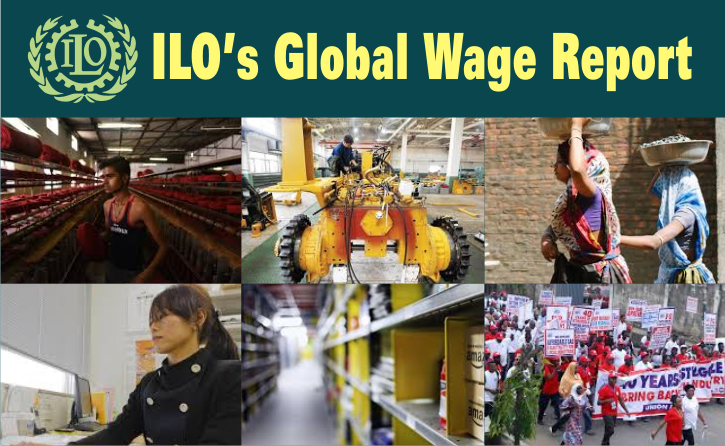
ILO Global Wage Report 2018/19, based on data from 136 countries, finds that Global Wage Growth in 2017 has been lowest since 2008 and is far below the level of Global Financial Crisis.
- Global Wage Growth in real terms (adjusted for price inflation) declined to 1.8%in 2017 from 2.4% in 2016.
- In advanced G20 countries real wage growth declined from 0.9% in 2016 to 0.4% in 2017.
- In emerging and developing G20 countries, real wage growth fluctuated between 4.9% in 2016 and 4.3% in 2017.
- In advanced G20 countries they have increased by just 9% in the last 20 years.
- In emerging and developing G20 countries average real wages have almost tripled in the last 20 years.
- In many low- and middle-income economies, wage inequality remains high and wages are frequently insufficient to cover the needs of workers and their families.
- India recorded the highest average real wage growth in South Asia during 2008 to 2017.
- India led the average real wage growth in 2008 to 2017 at 5.5 against a regional median of 3.7.
- Nepal was at 4.7, Sri Lanka at 4, Bangladesh at 3.4, Pakistan at 1.8 and Iran at 0.4.
- Workers in Asia and the Pacific have enjoyed the highest real wage growth among all regions over the period 2006–17.
- Countries such as China, India, Thailand and Vietnam are leading the way.
- S. wage growth remained unchanged 0.7% and Europe, excluding Eastern Europe, stalled at about zero last year.
ILO Director-General Guy Ryder said, “It’s puzzling that in high-income economies we see slow wage growth alongside a recovery in GDP growth and falling unemployment. And early indications suggest that slow wage growth continues in 2018” and added, “Such stagnating wages are an obstacle to economic growth and rising living standards. Countries should explore, with their social partners, ways to achieve socially and economically sustainable wage growth.”
Gender Pay Gap – at about 20% globally remains unacceptably high:
Global Wage Report calculates Gender Pay Gaps in innovative and more accurate ways, using data covering some 70 countries and about 80% of wage employees worldwide. It finds that globally women continue to be paid approximately 20% than men. Using empirical evidence, the report also shows that traditional explanations, such as differences in the levels of education between men and women who work in paid employment, play a limited role in explaining gender pay gaps.
- Gender Pay Gap is wider at the high end of the pay scale in high-income countries.
- Gender Pay Gap is wider amongst the lower paid workers in low- and middle-income countries.
Motherhood is another factor which weighs on the gender wage gap as mothers tend to have lower wages compared to non-mothers. This may be related to a host of factors, including labour market interruptions, reductions in working time, employment in more family-friendly jobs with lower wages, or stereotypical promotion decisions at enterprise level.
ILO Director-General Guy Ryder, said, “The gender pay gap represents one of today’s greatest manifestations of social injustice, and all countries should try to better understand what lies behind them and accelerate progress towards gender equality”.
Rosalia Vazquez-Alvarez, econometrician and wage specialist at the ILO and one of the authors of the report said, “In many countries women are more highly educated than men but earn lower wages, even when they work in the same occupational categories” and added, “The wages of both men and women also tend to be lower in enterprises and occupations with a predominantly female workforce. To reduce gender pay gaps more emphasis therefore needs to be placed on ensuring equal pay for women and men, and on addressing the undervaluation of women’s work.”
Related Articles
-
 Nov 14, 2018 17:00 pm





Related Articles
-
Created at: Jan 22, 2020
-

Created at: May 29, 2019
-

Created at: May 28, 2019
-

Created at: May 27, 2019
-

Created at: May 27, 2019
-

Created at: May 26, 2019
-
Created at: May 26, 2019