
Social Media
Imagine Reading by the Light of a Glowing Plant on Your Desk
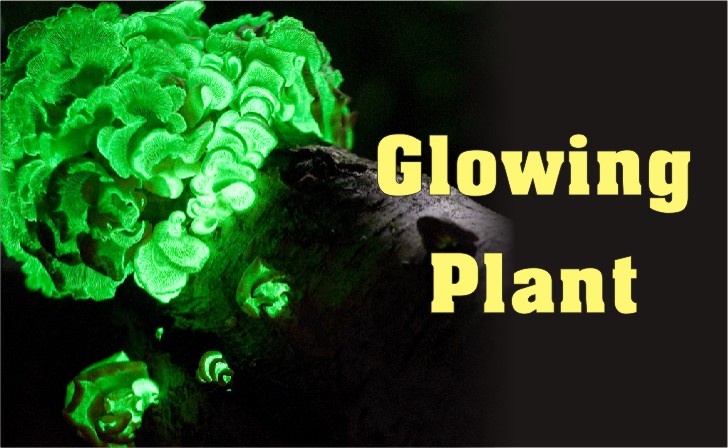
Plants induced to give off dim light for 4 hours, by a team of scientists lead by Professor Michael Strano from Massachusetts Institute of Technology (MIT) and University of California, by embedding specialized nanoparticles into the leaves of the Watercress (Nasturtium officinale), a major step towards realising their vision of using plants to illuminate the workspace. As published in the journal ‘Nano Letters’ researchers have found a way to infuse plants with the luminescence of fireflies, which could help reduce our dependence on conventional lighting.
According to Michael Strano Professor of Chemical Engineering at MIT, “The vision is to make a plant that will function as a desk lamp, a lamp that you don’t have to plug in. The light is ultimately powered by the energy metabolism of the plant itself.”
- To create their glowing plants, the MIT team turned to luciferase, the enzyme that gives fireflies their glow.
- Luciferase acts on a molecule called luciferin, causing it to emit light.
- Another molecule called co-enzyme A helps the process along by removing a reaction by product that can inhibit luciferase activity.
- Researchers packaged each of these three components into a different type of nanoparticle carrier.
- Researchers used silica nanoparticles about 10 nanometers in diameter to carry luciferase, and they used slightly larger particles of the polymers PLGA and chitosan to carry luciferin and coenzyme A, respectively.
- To get the particles into plant leaves, they first suspended the particles in a solution.
- Plants were immersed in the solution and then exposed to high pressure, allowing the particles to enter the leaves through tiny pores called stomata.
- Particles releasing luciferin and coenzyme A were designed to accumulate in the extracellular space of the mesophyll, an inner layer of the leaf, while the smaller particles carrying luciferase enter the cells that make up the mesophyll.
- The particle carriers gradually release luciferin, which then enters the plant cells, where luciferase performs the chemical reaction that makes luciferin glow.
- Illumination from nanobionic plants might one day replace some low-intensity lighting.
This technology could also be used to provide low-intensity indoor lighting, or to transform trees into self-powered streetlights. Imagine that instead of switching on a lamp when it gets dark, you could read by the light of a glowing plant on your desk.
Plant nanobionics, a new research area, aims to give plants novel features by embedding them with different types of nanoparticles. The group’s goal is to engineer plants to take over many of the functions now performed by electrical devices. The researchers have previously designed plants that can ‘Detect Explosives’ and communicate that information to a smartphone, as well as plants that can ‘Monitor Drought Conditions’.
Lighting, which accounts for about 20% of worldwide energy consumption, seemed like a logical next target. As the Plants can self-repair, they have their own energy, and they are already adapted to the outdoor environment, this is an idea whose time has come. It’s a perfect problem for plant nanobionics.
Related Articles
-
 Dec 20, 2018 17:00 pm




Related Articles
-

Created at: May 29, 2019
-

Created at: May 28, 2019
-

Created at: May 27, 2019
-

Created at: May 27, 2019
-

Created at: May 26, 2019
-
Created at: May 26, 2019
-

Created at: May 25, 2019