
Social Media
India upholds Net Neutrality whereas US repeals Network Neutrality
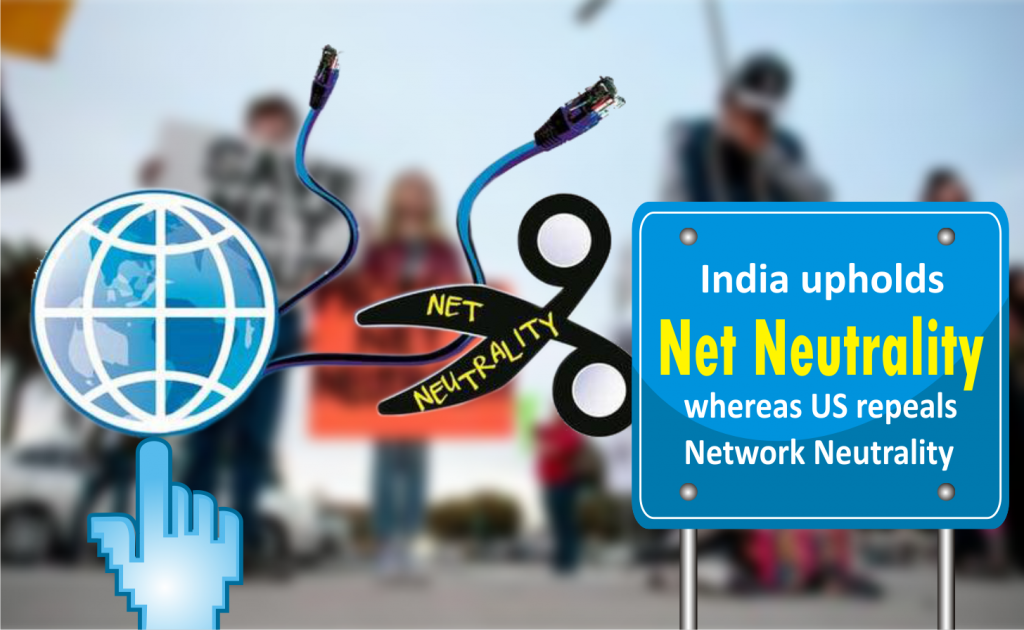
Net Neutrality, which means that telecom and Internet service providers must treat all data on the Internet equally, and not discriminate or charge differently by user, content, site, platform, or application; has been approved by the Telecom Commission (TC): the highest decision-making body in the Department of Telecom, on Wednesday July 11, 2018, as recommended by the Telecom Regulatory Authority of India (TRAI) eight months ago in November, 2017. This move that will ensure open and free Internet in India as telecom and Internet service providers now cannot engage in practices such as blocking, slowing down or granting preferential speeds to any content. Certain emerging and critical services that may include autonomous vehicles, digital healthcare services or disaster management will however be kept out of the purview of net neutrality.
The underlying principle of net neutrality is that the users should have neutral access to all lawful content and applications on the internet, regardless of the source, without the government or Internet service providers (ISPs) influencing their choices through pricing or selective access.
Without specific net neutrality regulations, ISPs can block or slow down internet speeds for select sites, or provide preferential treatment to certain content providers over others. For instance, a telecom operator can enter into an agreement with a company and allow faster access to its website compared to others, or bar the entry of new players in that particular area. But laws upholding net neutrality prevent this.
Highlights of TRAI recommendations on Net Neutrality:
- Discriminatory treatment of content is prohibited. Internet access services should be governed by a principle that restricts any form of discrimination or interference in the treatment of content, including practices like blocking, degrading, slowing down or granting preferential speeds or treatment to any content.
- Content Delivery Networks (CDN) has been kept out of the regulation. CDNs enable telecom deliver content within their network without going through the public internet in order to create a content ecosystem to drive user traction. Telecom firms such as Airtel, Reliance Jio stand to gain.
- Internet of Things (IoT), as a class of services, is included in scope of restrictions on non-discriminatory treatment. However, critical IoT services, which may be identified by department of telecom as specialised services which could include telemedicine, B2B services will be automatically excluded.
- Watchdog for enforcing Net Neutrality with reasonable measures of traffic management has been recommended by TRAI in line with its guidelines.
- International treaties, court orders, government order on blocking certain sites are exempt from Net Neutrality guidelines.
In United States, Federal Communications Commission (FCC) had adopted in 2005 network neutrality principles, “to preserve and promote the vibrant and open character of the Internet as the telecommunications marketplace enters the broadband age.” FCC’s network neutrality principles were challenged by large broadband Internet access service providers (ISPs) and in 2014 the District Columbia Circuit Court of Appeals ruled that FCC could not regulate the ISPs so closely.
In the US repeal of rules of FCC took effect on June 11, 2018, ending network neutrality regulation, which paves the way for service providers to block or slow down access to particular content for users.
India’s decision to uphold Net neutrality assumes greater significance given that in the U.S., the rules on Net neutrality were recently repealed.
Related Articles
-
 Aug 18, 2018 12:00 pm








Related Articles
-
Created at: Jan 22, 2020
-

Created at: Nov 2, 2019
-

Created at: May 29, 2019
-

Created at: May 28, 2019
-

Created at: May 28, 2019
-

Created at: May 27, 2019
-

Created at: May 27, 2019