
Social Media
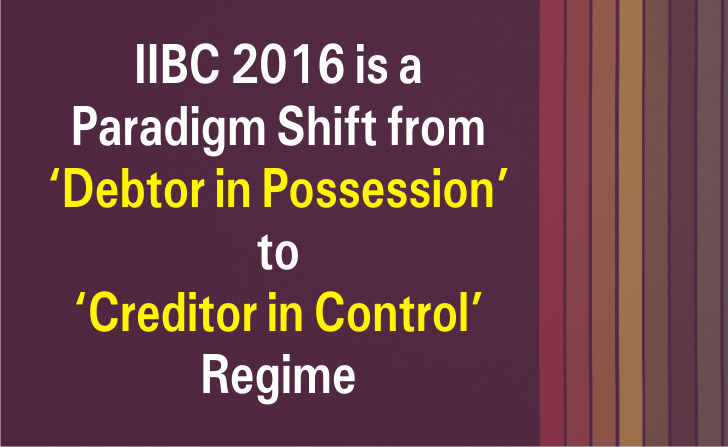
Insolvency and Bankruptcy Code, 2016 is a paradigm shift from ‘Debtor in Possession’ to ‘Creditor in Control’ regime
Insolvency and Bankruptcy Code, 2016 (IBC) was passed by parliament in May 2016 and became effective in December 2016 with the aim to consolidate the laws relating to reorganisation and insolvency of companies and limited liability entities, unlimited liability partnerships and individuals, into a single legislation to provide for a greater clarity in law and facilitate the application of consistent and coherent provisions to different stakeholders affected by business failure or inability to pay debt. Provisions of this Code override other existing laws on matters pertaining to Insolvency and Bankruptcy. This is considered as the biggest economic reform next only to GST.
IBC’s objective is to promote entrepreneurship, availability of credit, and balance the interests of all stakeholders including alteration in the order of priority of payment of Government dues and to establish an Insolvency and Bankruptcy Board of India; by consolidating and amending the laws in a time bound manner and for maximization of value of assets of such persons and matters connected therewith or incidental thereto.
Salient Features of Insolvency and Bankruptcy Code, 2016:
- Clear, coherent and speedy process for early identification of financial distress and resolution of companies and limited liability entities if the underlying business is found to be viable.
- Two distinct processes for resolution of individuals, namely- “Fresh Start” and “Insolvency Resolution”.
- Enabling provisions to deal with cross border insolvency.
- Insolvency and Bankruptcy Code has Four Pillars of Institutional Infrastructure:
- Insolvency Professionals to handle the commercial aspects of insolvency resolution process. Insolvency professional agencies to develop professional standards, code of ethics and be first level regulator for insolvency professionals members leading to development of a competitive industry for such professionals.
- Information utilities to collect, collate, authenticate and disseminate financial information about lenders and terms of lending in electronic databases to be used in insolvency, liquidation and bankruptcy proceedings. This is to eliminate delays and disputes about facts when default does take place.
- Adjudicating Authority as Debt Recovery Tribunal and National Company Law Tribunal to deal with the cases related to insolvency, liquidation and bankruptcy process in respect of individuals and unlimited partnership firms and in respect of companies and limited liabilities entities respectively. These institutions, along with their Appellate bodies, viz., NCLAT and DRATs to be adequately strengthened so as to achieve world class functioning of the bankruptcy process.
- Insolvency and Bankruptcy Board of India to exercise regulatory oversight over insolvency professionals, insolvency professional agencies and information utilities.
IBC is a paradigm shift from the existing ‘Debtor in possession’ to a ‘Creditor in control’ regime. The essential idea is that when a firm defaults on its debt, control shifts from the shareholders / promoters to a Committee of Creditors that has 180 days (extendable up to 270 days for the Company) to evaluate proposals from various players about resuscitating the company or taking it into liquidation. When decisions are taken in a time-bound manner, there is a greater chance that the firm can be saved as a going concern, and the productive resources of the economy can be put to the best use.
IBC’s vision is to encourage entrepreneurship and innovation. Some business ventures will always fail, but they will be handled rapidly and swiftly. Entrepreneurs and lenders will be able to move on, instead of being bogged down with decisions taken in the past.
IBC is thus a comprehensive and systemic reform, to give a quantum leap to the functioning of the credit market. It would take India from among relatively weak insolvency regimes to becoming one of the world’s best insolvency regimes. It lays the foundations for the development of the corporate bond market, which would finance the infrastructure projects of the future. The IBC implementation will give a big boost to ease of doing business in India.
Related Articles
-
 Apr 14, 2018 12:00 pm






Related Articles
-
Created at: Jan 22, 2020
-

Created at: Nov 2, 2019
-

Created at: May 29, 2019
-

Created at: May 28, 2019
-

Created at: May 28, 2019
-

Created at: May 27, 2019
-

Created at: May 27, 2019