
Social Media
International Energy Forum for Consensus on Responsible Pricing
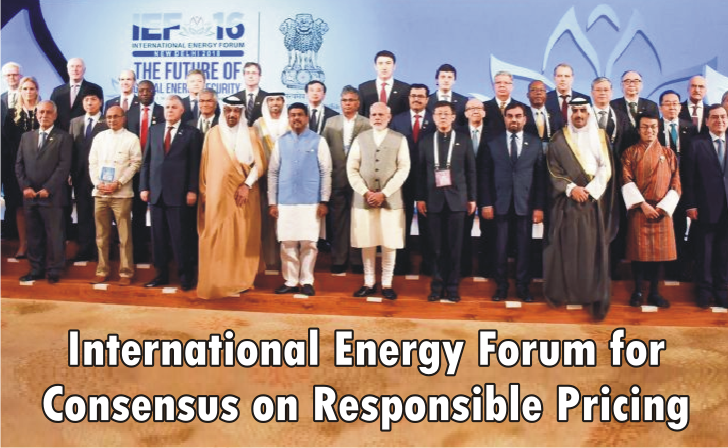
“The Future of Global Energy Security – Transition, Technology, Trade and Investment” was the theme of the 16th biennial International Energy Forum Ministerial Meeting (IEF16) hosted by the Government of India with the support of the Peoples Republic of China and the Republic of Korea as IEF16 co-hosts in New Delhi on 10-12 April 2018. India’s Prime Minister Narendra Modi while inaugurating IEF16 Ministerial meeting shared his energy vision comprising of 4 pillars: Energy Access, Energy Efficiency, Energy Sustainability and Energy Security. He called for a mutually supportive relationship between and consumers if the world has to grow as a whole. He also called for optimal use of the neutral platform of the IEF to build a global consensus on ‘responsible pricing’, that serves the mutual interests of both producers and consumers.
IEF16 comes in the backdrop of a supply cut by the Organisation of the Petroleum Exporting Countries (OPEC) and Russia that has led to a rally in global oil price. This has resulted in the cost of Indian basket of crude, which averaged $47.56 a barrel in 2016-2017, touching $63.80 (average price) in March 2018. The Indian basket represents the average of Oman, Dubai and Brent crude. As a major consumer, India is trying to leverage its position to seek reasonable rates and reworking its import strategy by stepping up the share of short-term contracts whenever the market is favourable and exploring long-term supply deals at discounted prices as its new energy architecture evolves.
IEF, world’s largest recurring gathering of energy ministers covering all six continents and accounting for around 90% of global supply and demand for oil and gas, provides to strengthen international cooperation on energy through dialogue, ministers, industry leaders, and heads of international organisations sharpened collective focus on how global shifts, new policies and technologies change, investment and trade patterns and influence energy market security, facilitate orderly transitions, and accelerate the achievement of shared goals. IEF comprises consuming and producing countries of the IEA and OPEC, as well as Transit States and major players outside of their memberships, including Argentina, China, India, Mexico, Russia and South Africa.
IEF aims to foster greater mutual understanding and awareness of common energy interests among its 72 Member Countries that are signatories to the IEF Charter, which outlines the framework of the global energy dialogue through this inter-governmental arrangement.
IEF16 discussions were focussed on:
- Global shifts: The Future of Global Energy Security – Finding New Balances
- Sustainable and Inclusive Growth – Energy Access and Affordability
- Oil and Gas Market Stability and Change – Investment in a New Era
- Uptake of Clean Technologies: Disruption and Coexistence of New and Existing Technologies – The Way Ahead
Prime Minister Modi during his inaugural address, at the IEF16 Ministerial Meeting on April 11, 2018, to a large participation of Energy Ministers from producing and consuming nations, Heads of International Organisations and CEOs that had come together to discuss the future of global energy, stated that the world is seeing a great transition in energy supply and consumption. Quoting an energy forecast he said that India will be the key driver of global energy demand in the next 25 years. India’s energy consumption will grow by 4.2% a year for the next 25 years. This is fastest among major world economies. The Gas demand will triple by 2040. The number of electric vehicles will rise to 325 million by 2030, up from 3 million today.
We are entering an era of energy abundance. However, 1.2 billion people still do not have access to electricity. Many more do not have access to clean cooking fuel. We must ensure that this situation is not exploited to the detriment of the under-privileged. People must have universal access to clean, affordable, sustainable and equitable supply of energy.
- Consumption growth has shifted to non OECD countries: Middle East, Africa and developing Asia;
- Solar Photo-Voltaic energy has become economical compared to all other energy sources. This is changing the supply paradigm;
- Abundant availability of natural gas globally with increased percentage of LNG and natural gas is contributing to the primary energy basket;
- The US may soon become the largest producer of oil. It is predicted to meet a major portion of the additional oil demand in the next few decades;
- Coal may gradually go out of favour as a major contributor to primary energy in the OECD World and later in developing countries;
- The Transport sector will see massive changes in the next few decades with adoption of electric vehicles;
- The World is committed to the climate change agenda based on the COP-21 agreement. The energy intensity of economies will change with focus on green energy and energy efficiency.
Dharmendra Pradhan, India’s Minister for Petroleum and Natural Gas and Minister for Skill Development and Entrepreneurship speaking at Concluding Session on April 12, 2018 said, “Today, we find ourselves at a critical juncture faced with a rapidly-transforming energy landscape bringing in changes that are not reversible. We are at such a point, when we have to assess the impact of disruptive technologies, innovations, changes in trade and investment patterns, geopolitics and climate change issues.”
Related Articles
-
 Apr 06, 2018 11:26 am


Related Articles
-
Created at: Jan 22, 2020
-

Created at: Nov 2, 2019
-

Created at: May 29, 2019
-

Created at: May 28, 2019
-

Created at: May 28, 2019
-

Created at: May 27, 2019
-

Created at: May 27, 2019