
Social Media
Leaning Tower of Pisa is Straightening & Recovering Tilt
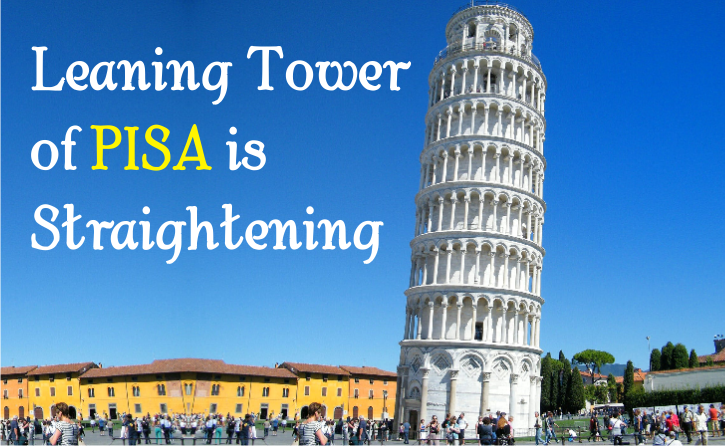
Leaning Tower of Pisa in Italy, gravitationally-challenged landmark, has slowly started defying its name, losing 4 centimetres of its tilt over the past 17 years and is leaning less after years of ambitious engineering work.
Leaning Tower of Pisa or simply the Tower of Pisa is freestanding medieval bell tower, of the Cathedral of the Italian city of Pisa, situated behind the Pisa Cathedral and is the third oldest structure in the city’s Cathedral Square, after the cathedral and the Pisa Baptistry. It is a symbol of the power of the maritime republic of Pisa in the middle ages.
- Height of the tower is 183.27 feet from the ground on the low side and 185.93 feet on the high side.
- Width of the walls at the base is 8 feet 0.06 inches.
- Its weight is estimated at 14500 metric tons.
- Tower has leaned to one side ever since building started in 1173, caused by an inadequate foundation on ground too soft on one side to properly support the structure’s weight.
- Tilt increased in the decades before the structure was completed in the 14th
- It gradually increased until the structure was stabilized (and the tilt partially corrected) by efforts in the late 20th and early 21st centuries.
- In 1990 the tower leaned at an angle of 5.5 degrees, as its tilt reached 15 feet (4.5 meters) from the vertical, threatening to turn it into a pile of rubble.
- Tower was closed to the public in January 1990 for 11 years over safety fears.
- Remedial work was undertaken between 1993 and 2001and the tilt was reduced to 3.97 degrees, reducing the overhang by 41cm at a cost of £200m.
- It lost a further 4 cm of tilt in the two decades to 2018.
Michele Jamiolkowski, an engineer of Polish origin who adopted Italian nationality, coordinated an international committee to rescue the landmark between 1993 and 2001.
Roberto Cela, Technical Director at Opera della Primaziale Pisana, the organisation responsible for maintenance of the square where the tower is located, said his team “positioned a series of pipes with drills which took away soil from the opposite side of the leaning side of the tower”, and added, “With the missing soil under its base, the tower has reacted by straightening up, recovering the tilt and thus rejuvenating after all the years that caused it to lean and to reach a critical position”.
Engineering lecturer Nunziante Squeglia of Pisa University, who works with the Surveillance Group set up after the rescue work, has been studying and measuring the tower for 25 years, said, “The tower was much more mysterious when I arrived, it wasn’t clear why it was leaning, and increasingly leaning,” and added “It is a building that has been extensively studied for over 100 years but there are still so many things to know,” including the remains of what looks like a domed roof inside the tower that is still unexplained.
According to Squeglia, “The tower tends to deform and reduce its lean in the summer, when it’s hot, because the tower leans to the south, so its southern side is warmed, and the stone expands. And by expanding, the tower straightens”.
Squeglia explains that there are three pendulums, one dating back to 1935, when systematic measurements began, although annual measurements began as far back as 1911.
Related Articles
-
 Apr 12, 2018 13:35 pm








Related Articles
-
Created at: Jan 22, 2020
-

Created at: May 29, 2019
-

Created at: May 28, 2019
-

Created at: May 28, 2019
-

Created at: May 27, 2019
-

Created at: May 27, 2019
-

Created at: May 26, 2019