
Social Media
Nayachar Island’s Study: Species Succession from Nascent Stage
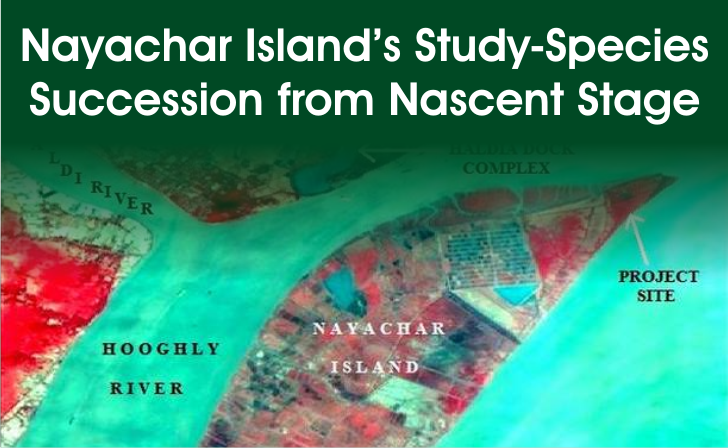
Nayachar, an island in the in the Hooghly River, off Haldia in Purba Midinipur District of West Bengal, derives its name from the Bengali words Naya meaning New and Char meaning a strip of sandy land rising out of the bed of a river or the sea above water-level. It was created in the Indian Sunderbans by river silt deposits, and remained largely submerged, rising occasionally above the water level. Island was renamed Meendwip, meaning fish island by Benfish the official agency of the fisheries department that undertook its development in December 1987, but nothing much seems to have happened.
Nayachar was completely barren with hardly any plant or animal species till 1990 and a recent study aimed at understanding soil stabilisation in an emerging island and succession of living organisms in a new habitat titled ‘Studies on the Succession and Faunal Diversity and Ecosystem Dynamics in Nayachar Island Indian Sundarban Delta’ published in October 2017 by the Zoological Survey of India (ZSI), has listed 151 animal species on the island, making it a rare case in ecology, as it reveals how an emerging landmass can gradually provide habitats for diverse groups of organisms. According to Dr. A. K. Hazra-former Additional Director ZSI, working on the project since 1989, and Dr. Gurupada Mandal-an expert on subsoil invertebrates, study spanning nearly three decades from 1990 to 2017, the first of its kind in India, documents the rare development of an ecosystem undisturbed by human intervention. Nayachar has provided that rare opportunity for researchers to study species succession from a very nascent stage:
- Nayachar is a mangrove ecosystem where a unique species succession has been observed.
- Scientist had found only three invertebrate soil fauna (organisms living under the soil) in 1989.
- After a couple of years, the number doubled and, by the late Nineties, 76 invertebrate fauna, both underground and terrestrial were recorded.
- The data so far places the number of animal species at 151.
- Soon after the emergence of Protista, the single-celled organisms, on the island, scientists could record salt-tolerant micro fauna from the Acarina and Collembola groups living under the soil.
- So far about 20 species of microfauna, which represent eight species of Acarina and six species of Collembola have been recorded.
- Increase in faunal species is seen in every group.
- A total of 27 species of fish have been recorded in the publication.
- The island has recorded 37 species of birds thus far.
- Mammals, mostly rats, mice, bats and squirrels, have increased in number from three in 1992 to 11 at present.
- The island is also home to 33 species of butterflies and moths, up from only 7 in 1992.
- Island has recorded a growth in species of fauna and as well as increase in size over the past five decades from 17.99 sq. km. to 46.29 sq. km.
- What’s interesting is that Nayachar is surrounded by water on all sides and the nearest landmass, the sinking island of Ghoramara is about 30 km away.
- The natural succession of species on the island has been aided by the inundation of water during tides, and the soil brought from other places by fishermen.
Related Articles
-
 Nov 21, 2017 17:00 pm







Related Articles
-
Created at: Jan 22, 2020
-

Created at: Nov 2, 2019
-

Created at: May 29, 2019
-

Created at: May 28, 2019
-

Created at: May 28, 2019
-

Created at: May 27, 2019
-

Created at: May 27, 2019