
Social Media
In 15th RIC Trilateral India tries Semblance of Balance
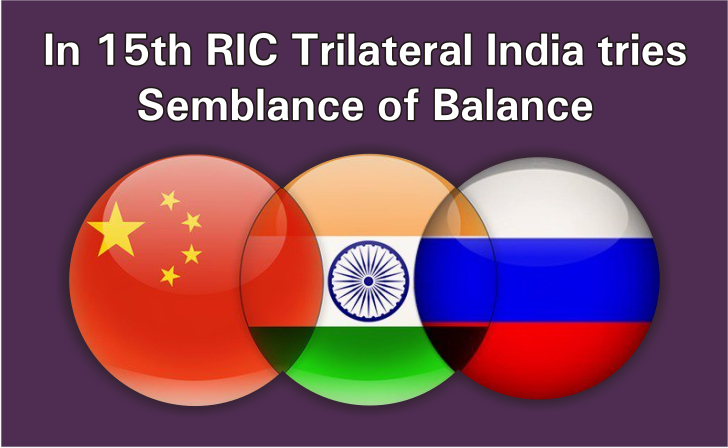
15th Russia-India-China (RIC) Trilateral Meeting held in New Delhi on 11 December 2017 can be construed as India’s attempt to get a semblance of balance in its ties with Moscow and Beijing. Foreign ministers of the RIC Sushma Swaraj (Minister of External Affairs of India), Wang Yi (China) and Sergey Lavrov (Russia) called for cooperation between the three countries in order to take decisive and concerted action against terrorism and resolved “to step up cooperation to prevent and counter terrorism and radicalisation, combat the spread of terrorist ideology and propaganda, stop sources of terrorist financing, prevent travelling of and the supply of arms to terrorists, and dismantle terrorist infrastructure,” and according to their joint communiqué, broader discussions, took place in the:
- Backdrop of the political scenario in West Asia and North Africa,
- Numerous challenges in putting the world economy back on the growth track,
- Concerns relating to terrorism, transnational organized crime, illicit drug trafficking, food security, and climate change.
Russia-India-China strategic triangle that would represent a force for greater regional and international stability had originally been proposed by Russian Prime Minister Yevgeny Primakov during his visit to India in 1998. This idea took a tangible form when former Foreign Ministers of Russia Igor Ivanov, China Tang Jiaxuan, and India Yashwant Sinha, met on the margins of the UN General Assembly in New York in September 2002. This was the first major attempt by the three nations to deliberate on world affairs, and since then has become a regular feature of interactions among the three states.
In the joint declaration of the recent trilateral meeting the three sides stated their interest, concern, and objectives on a range of issues.
- It stopped short of naming Pakistan-based terror groups such as Lashkar-e-Taiba and Jaish-e-Mohammed.
- It stressed that those committing, organizing, inciting or supporting terrorist acts must be held accountable and brought to justice under international law, including the principle of extradite or prosecute.
- It did mention freedom of navigation, but made no reference to the South China Sea specifically: “Recognising the growing importance of maritime-trade in an increasingly globalised world, we support freedom of navigation and over flight rights based on the principles of international law, particularly UNCLOS”. The United Nations Convention on the Law of the Sea (UNCLOS) also called the Law of the Sea Convention or the Law of the Sea treaty is the international agreement that resulted from the third United Nations Conference on the Law of the Sea (UNCLOSIII), which took place between 1973 and 1982.
- Reaffirmed commitment to work together to ensure that the modalities for implementing the Paris Agreement adopted under the UN Framework Convention on Climate Change are framed to reflect equity and Common but Differentiated Responsibility as recognised under the UNFCCC.
- Other issues referred are regional connectivity, tensions on the Korean Peninsula, in eastern Ukraine, and Afghanistan.
India is trying to leverage its partnership with other like-minded states in the wider Indo-Pacific region as Russia is getting closer to China. Both Russia and India have to deal with the externalities being generated by China’s rise. As a multipolar world order takes shape, India will have to engage with multiple partners.
Sushma Swaraj in her address in the trilateral meeting stated that these annual talks give an opportunity to three countries to exchange mutual views and identify contributions to international peace, security and development. Discussions were focused on four broad cluster of areas, namely, Economic and Developmental issues; Fight against terrorism; Global / Multilateral issues; and Regional issues; besides the challenges of the Global Economy, natural and man-made disasters, climate change, and changing political scenario in Middle East and North Africa.
She invited China and Russia for a more intensive trade and economic partnership so that they can take advantage of the economic opportunities available in India stating that in the recently released Ease of Doing Business report by World Bank India has improved its position from 142nd in 2014 to 100th place this year. Referring to UN Summit on Sustainable Development, she pointed out India’s own vision of development with poverty eradication as its overarching focus, and added that the Government of India’s initiatives such as Smart Cities, Make in India, Beti Bachao Beti Padhao, Swachh Bharat, Jan Dhan Yojana, Digital India, Skill India, Startup India etc., closely relate to several targets under the SDGs.
Related Articles
-
 Apr 26, 2017 11:28 am

Related Articles
-
Created at: Jan 22, 2020
-

Created at: Nov 2, 2019
-

Created at: May 29, 2019
-
Created at: May 28, 2019
-

Created at: May 28, 2019
-
Created at: May 27, 2019
-
Created at: May 27, 2019