
Social Media
Transforming India Invites ASEAN to Participate in Growth Story
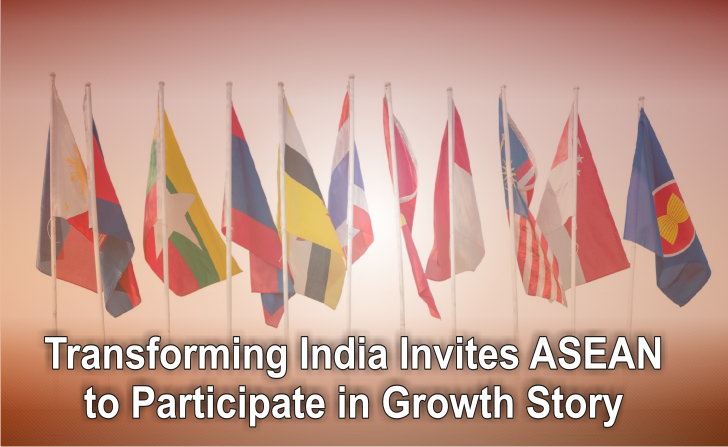
Prime Minister Narendra Modi while addressing ASEAN Business & Investment Summit in Manila on 13 November 2017 vowed to bring India’s economic and business ties with the region up to the level of their exceptionally good political and people-to-people relations, stating that the Act East policy of his government puts ASEAN region at the centre of engagement. He expected that the ASEAN business community recognises the potential for business in India adding that while some of them are already deeply involved in India, others are just discovering the possibilities that remain to be tapped. He also set the stage for closer engagement ahead of the 25th year Commemorative Summit to be held in Delhi in January 2018, and informed that India was also organising the ASEAN-India Business and Investment Meet and Expo. Modi assured that it will be the biggest ASEAN focussed business event India has ever organised. He also extended invitation to ASEAN leaders to attend Republic Day festivities, and added, “India wishes to participate in your growth story and we invite all of ASEAN to participate in ours.”
Modi informed the leaders that, “The task of transforming India is proceeding on an unprecedented scale. We are working day and night to ensure Good Governance which includes easy, effective and transparent Governance”. He elaborated with the following examples:
- “We have started open auction for natural resources including telecom spectrum, coal mines and other minerals and even private radio channels. This has together contributed about 75 billion US dollars in revenue.
- Using technology, we are enhancing responsibility and reducing discretion and corruption.
- We are using our Unique ID system in financial transactions and taxation for this purpose and the results are already visible.
- Demonetization of high value notes has resulted in formalizing a large part of our economy.
- The number of new tax payers filing income tax returns has more than doubled.
- Digital transactions have increased by 34% in one year, as we march towards a less-cash economy.
- We have used technology to reach out to people.
- An online citizen engagement platform, MyGov has harnessed ideas, suggestions and inputs on policies and programmes from 2 million pro-active citizens.
- We have also introduced a new frame-work called PRAGATI – Pro-active Governance and Timely Implementation under which I am able to review project implementation and redress public grievances through video conference with officials across the country.
- In keeping with our emphasis on minimum government and maximum governance, 1200 out-dated laws have been repealed in three years.
- New laws and institutions for Bankruptcy and Insolvency as well as IPR and Arbitration are now in place.
- 36 white industries have been taken out from the requirement of environmental clearance.
- Incorporating a company is now just a one day affair.
- We have simplified industrial licensing, and introduced online application process for environmental and forest clearances.
- All these have made opening a new business very easy.”
Modi further stated that, “The results are obvious and, the World is taking notice:
- India has climbed 30 places in the World Bank Ease of Doing Business Index this year. It is the biggest jump by any country this year and a recognition of India’s long term reform trajectory.
- We have moved up 32 places in the last two years in the Global Competitiveness Index of the World Economic Forum;
- We have also moved up 21 places on the Global Innovation Index of WIPO in two years.
- We have moved 19 places on the Logistics Performance Index of 2016 of World Bank.
“Now, we are a globally integrated economy:
- Most of the sectors of our economy are now open for FDI.
- More than 90 per cent FDI sectors are on automatic approval route.
- India has emerged as a front-runner in attracting foreign direct investment.
- Compared to last three years, we have received 67 per cent more FDI in this year.”
Goods and Services Tax:
“Moreover, these mile-stones have been achieved even before some of the major recent reforms. This year in July, we have implemented the highly complex task of migrating to a uniform Goods and Services Tax for the whole country. This has done away with a vast range of State level and central level taxes throughout India. This is no small achievement given the vastness and diversity of our country and the federal nature of our polity.”
Jan Dhan Yojana:
“A very large part of India’s population had no access to banking services. This deprived them of the opportunities for savings as well as access to institutional credit. With the Jan Dhan Yojana, within a matter of months, the lives of millions of Indians were transformed. 197 million bank accounts were opened in one year.
Till August this year, 290 million such accounts have been opened in Indian banks. Nearly 200 million Rupay cards were issued for easy cash-less transactions. Access to banking services by the poor has also played a major role in tackling corruption in government.”
Direct Benefit Transfers:
“Now, subsidies meant for the poor get directly deposited into their accounts in the form of direct benefit transfers, eliminating leakages and possibility of any discrimination.
More than 146 million people are receiving direct cash subsidies through bank accounts on cooking gas alone. Today, the government is using Direct Benefit Transfers for 59 different schemes. Subsidies worth nearly 10 billion US dollars are being directly transferred to the bank accounts of the intended beneficiaries.”
Make in India, Start-up India and Stand-up India:
“One of the major themes of this summit is entrepreneurship. We have launched a campaign called Make in India. Through this initiative, we are committed to transform India as a major player in the global value chain. We want to make India a global manufacturing hub. At the same time, we want our youth to be job creators; not just job seekers. For this purpose, we have launched drives called Start up India and Stand up India. A major constraint in freeing up the enterprising energy of small entrepreneurs is lack of collateral for finance.
Mudra scheme:
For the first time in India, collateral-free loans have been disbursed to more than 90 million small entrepreneurs under the Mudra scheme. Very near to the population of Philippines. This is recognition of the contribution of small entrepreneurs in the economy and to empower a person who has a workable business idea but no collateral. I see the importance being given to entrepreneurship in the Philippines and in ASEAN region.
The ASEAN Mentorship for Entrepreneurs launched at this Summit is a commendable initiative that addresses another felt need of entrepreneurs.”
Connectivity with ASEAN is a key objective for India:
“Indeed, for the near future, South and South East Asia will be the growth engine of the world.
We wish to build land, sea and air connectivity to this dynamic region. Work is already on in the construction of the trilateral highway through Myanmar and Thailand to connect to other countries in South East Asia.
We are working on the early conclusion of the Agreement on Maritime Transport between India and ASEAN and are exploring coastal shipping services with countries that are our immediate maritime neighbours. In the area of air connectivity, ASEAN countries enjoy the facility to operate a daily service to the four metro cities in India and to eighteen other destinations.
We have taken steps such as electronic visa system to boost tourism to India. Out-bound tourism from India is growing at one of the fastest rates in the world. Given the primacy of connectivity, India is organising an ASEAN – India Connectivity Summit in New Delhi next month with Ministers, officials and business representatives from all ASEAN countries participating.”
Related Articles
-
 Apr 09, 2018 17:00 pm

Related Articles
-
Created at: Jan 22, 2020
-

Created at: Nov 2, 2019
-

Created at: May 29, 2019
-

Created at: May 28, 2019
-
Created at: May 28, 2019
-
Created at: May 27, 2019
-
Created at: May 27, 2019