
Social Media
Varanasi Is Now Seeing Transformation Never Envisioned Before
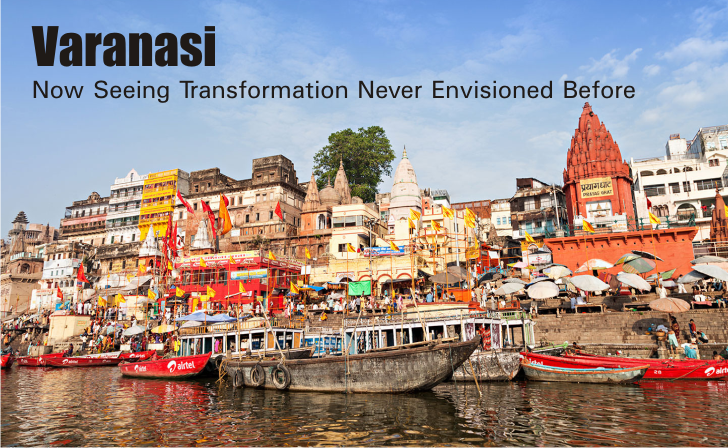
Varanasi emerging as the gateway to east India will soon be a reality with model national highways construction, waterways development, air connectivity, rail network and freight corridor; as stated by the President Ram Nath Kovind while addressing a function hosted by National Highway Authority of India (NHAI) and Skill Development Department of Uttar Pradesh at Deen Dayal Upadhyaya Trade Facilitation Centre on March 26, 2018. President attended various events organized by NHAI and the State government including laying two projects worth Rs 3473 crores of NHAI. Varanasi currently connects north and southern parts of India through rail and road. The government is focusing on infrastructure and connectivity to make Varanasi an economic hub.
President said, “Modi is making continuous efforts for the development of Varanasi enabling the city to get global recognition. The visits of head of nations including Japanese PM Shinzo Abe, Presidents of France and Germany in recent past prove the same. This is the only city which produced five Bharat Ratna including former PM Lal Bahadur Shastri, Bhagwan Das, Pt Ravi Shankar, Bismillah Khan and Mahamana Madan Mohan Malviya”.
Varanasi, name derived from combination of ‘Varuna’ and ‘Asi’ on the names of rivers, also called as Banaras or Kashi, the cradle of India’s glorious culture, a confluence of tradition, history, culture and harmony, is a city in the northern Indian state of Uttar Pradesh dating to the 11th century B.C. Regarded as the spiritual capital of India, the city draws Hindu pilgrims who bathe in the Ganges River’s sacred waters and perform funeral rites. Along the city’s winding streets are some 2,000 temples, including Kashi Vishwanath, the “Golden Temple,” dedicated to the Hindu God Shiva. As the Lok Sabha constituency of the Prime Minister Narendra Modi Varanasi is now seeing a transformation never envisioned before:
- Varanasi is set to create history having already established itself as a special place in India’s heritage with Prime Minister Narendra Modi and his government’s special efforts to showcase this ancient centre to the world as one of the cleanest, connected and conserved place on earth.
- All efforts are on to make this city a World Heritage site with focus on state of the art tourism and infrastructure facilities including a major thrust towards cleanliness under the Swachh Bharat Mission.
- Prime Minister has taken up the cleanliness drive with a personal involvement and regular monitoring and results are already beginning to show.
- In Varanasi wi-fi connectivity along the major ghats is now a reality.
- Special partnership agreement with Japanese city of Kyoto will help Varanasi demonstrate the diversity and depth of Indo-Japan relationship and its human dimension.
- Prime Minister has also put a major emphasis on job creation in the region with the help of Indian Railways and by reviving the textile and power-loom industry.
- Integrated power development scheme (IPDS) project for underground cabling work of over 16 sq-km has been completed by Powergrid and there is substantial improvement with almost 24×7 Electric supplies.
- Trauma Center has been inaugurated and foundation lay of the Cancer Research Institute.
Jayapur selected under Saansad Adarsh Gram Yojana by Narendra Modi, once sleepy village, which did not even have a post office until 2014, has become a centre of attraction nationally and internationally. With stress on clean energy, a pet topic of the PM, Jayapur has been transformed as it now has from ‘Solar Electricity’ generation to ‘Fancy Interlocked Stone Pathways’ to ‘Steel Benches’ at bus shelters to a ’14-House Residential Complex’ for the poorest of the poor. The village boasts two 25-kw solar power plants capable of lighting up 2 LED bulbs and a mobile charging point at each house in the village, a toilet attached with every house and 12 public bio-toilets. Besides 135 solar street lamps, the newly-built girls’ primary school and the Anganwadis also have solar power. Solar water pumps also provide drinking water. The village gets close to 12 hours water but it’s never in the dark. Everything related to Jayapur today results in folklore, which even the city’s travel agents are more than happy to share. In fact, the village is a prominent addition to Varanasi’s numerous sightseeing locations.
Related Articles
-
 Jan 20, 2017 09:25 am


Related Articles
-
Created at: Jan 22, 2020
-

Created at: May 29, 2019
-
Created at: May 28, 2019
-

Created at: May 28, 2019
-
Created at: May 27, 2019
-
Created at: May 27, 2019
-
Created at: May 26, 2019