
Social Media
WHO Report on Ambient Air Pollution Alarms India
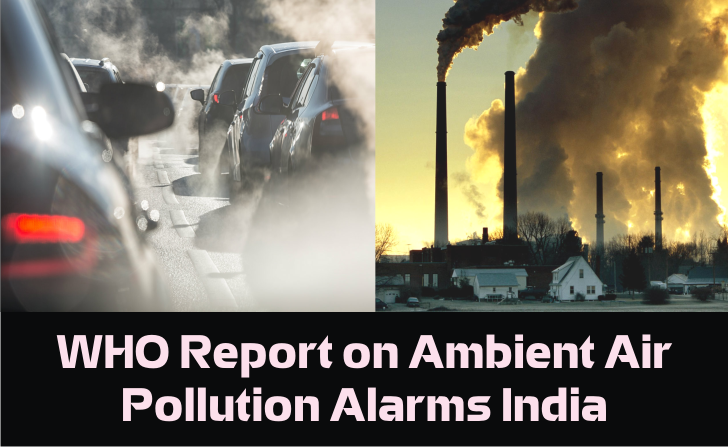
World Health Organization (WHO) report that states 9 out of 10 people in the world breathe air containing high levels of pollutants figured 14 Indian cities in a list of 20 most polluted ones in the World in terms of PM2.5 levels in 2016 and warns that the combined effects of household air pollution and ambient air pollution will become increasingly hard to address if not tackled early. In terms of PM10 levels, eight cities in India figured among the 20 most-polluted cities of the world in 2016 as per the report.
Responding to the WHO report, Ministry of Environment, Forest and Climate Change (MoEF) said on Wednesday May 2, 2018 that Indian government has made “serious” efforts to fight air pollution and the 2017 air quality data for fine particulate matter PM2.5 has shown improvement over the previous year. MoEF said, “Data for the year 2017 for PM2.5 shows an improvement over 2016 and so far in 2018, it shows a further improvement, as compared to 2017. The government has also taken several bold initiatives, including leap-frogging from BS-IV to BS-VI.”
WHO report ranked serially from 1 to 14, with PM2.5 level mentioned in brackets, Kanpur (173), Faridabad (172), Varanasi (151), Gaya (149), Patna (144), Delhi (143), Lucknow (138), Agra (131), Muzaffarpur (120), Srinagar (113), Gurgaon (113), Jaipur (105), Patiala (101) and Jodhpur (98); followed by Ali Subah Al-Salem in Kuwait ( 94) – ranking at 15; and a few cities in China and Mongolia.
- WHO report highlights widespread air pollution and deficient air quality monitoring in urban India.
- WHO researchers have used alternative data sources such as satellite remote sensing and chemical transport models, along with ground-monitoring stations.
- Such wide variations in data quality exist across the world.
- Europe has the most extensive monitoring network
- Data from countries in Africa and the Western Pacific regions are of poor quality, and likely underestimates, result in an under-count of the disease burden.
- WHO report puts the global death toll from air pollution at seven million a year, attributable to illnesses such as lung cancer, pneumonia and ischemic heart disease.
- In 2016 alone around 4.2 million people died owing to outdoor air pollution, while 3.8 million people succumbed to dirty cooking fuels such as wood and cow dung.
- About a third of these deaths occurred in Southeast Asian countries, which include India.
- Once monitoring improves in these regions, the numbers will likely be revised upwards.
- WHO report had words of praise for India’s Pradhan Mantri Ujjwala Yojana, which has provided 37 million women living below the poverty line with LPG (liquefied petroleum gas) connections.
- Such schemes will also help cut the indoor air pollution that plagues much of rural India, which is not covered in the WHO analysis.
- WHO has asked Southeast Asian countries to take swift action to tackle the twin problems of indoor and outdoor pollution
- India must realise that its problems are larger than the WHO estimates, and take the call to action seriously.
According to MoEF most of the polluted cities lie around Delhi and along the Indo-Gangetic plain, it is critical that the governments of Uttar Pradesh, Bihar and West Bengal are sensitised to take up urgent action on cleaning air. MoEF added, “It is noteworthy that almost one million vehicles are added on the roads of Delhi every year and in spite of increased construction activities and vehicular movement, air quality in Delhi is showing signs of improvement.” “With similar intervention in other polluted cities and active participation of Urban Local Bodies and State governments, air quality is expected to improve further.”
Central Pollution Control Board (CPCB) data based on Continuous Ambient Air Quality Monitoring Stations (CAAQMS) noted Delhi’s PM2.5 level has come down to 125 micrograms/cubic metre in 2017; and that PM 10 figures were 289 micrograms per cubic metre in the year 2016 and 268 micrograms per cubic metre in the year 2017.
Related Articles
-
 Feb 05, 2018 15:59 pm







Related Articles
-

Created at: May 29, 2019
-

Created at: May 28, 2019
-

Created at: May 27, 2019
-

Created at: May 27, 2019
-

Created at: May 26, 2019
-
Created at: May 26, 2019
-

Created at: May 25, 2019