
Social Media
Global Warming Report Warns Climate Change Catastrophe
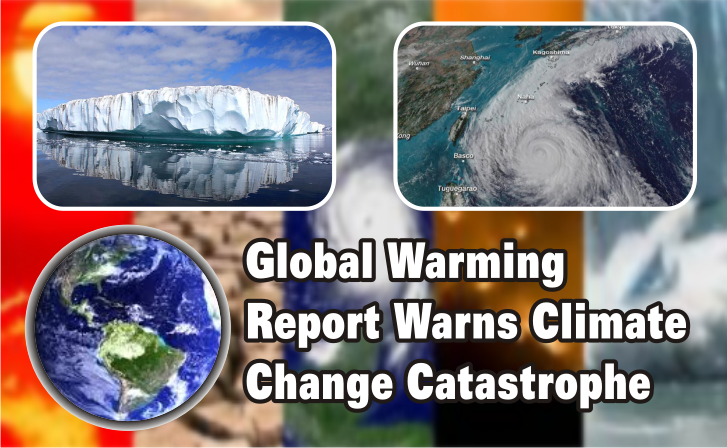
Special report on impacts of global warming at 1.5°C by the UN Intergovernmental Panel on Climate Change (IPCC), launched after approval at a final plenary of all 195 countries in Incheon in South Korea on Saturday 6 October and released on Monday 8 October 2018, has a warning by world’s leading climate scientists that there is only a dozen years for global warming to be kept to a maximum of 1.5°C, beyond which even half a degree will significantly worsen the risks of drought, floods, extreme heat and poverty for hundreds of millions of people. The report says the world must reset its goal to limit global warming to 1.5°C from 2.0°C and stresses that urgent and unprecedented changes are needed to cut risk of extreme heat, drought, floods and poverty, as half-degree difference could also prevent corals from being completely eradicated and ease pressure on the Arctic, according to the 1.5°C study. The report’s authors remain optimistic to reach the target, which they say is affordable and feasible although it is at the most ambitious end of the Paris agreement pledge to keep temperatures between 1.5°C and 2°C.
IPCC makes clear that climate change is already happening, upgraded its risk warning from previous reports and warned that every fraction of additional warming would worsen the impact, following devastating hurricanes in the US, record droughts in Cape Town and forest fires in the Arctic,
The world is currently 1°C warmer than preindustrial levels due to human-induced global warming; and with another half-degree rise many regions will have warmer extreme temperatures, raising frequency, intensity and amount of rain or severity of drought. Risks to food security and water, heat exposure, drought and coastal submergence all increase significantly even for a 1.5°C rise.
“Even at a little over 1.0°C warming, India is being battered by the worst climate extremes – it is clear that the situation at 1.5°C is going to worsen,” says Sunita Narain, Director General Centre for Science and Environment (CSE) and adds that the IPCC report, “has served us a final warning that we must get our act together — now and quickly.”
According to the report, “Global warming is likely to reach 1.5°C between 2030 and 2052 if it continues to increase at the current rate.” Report’s authors said, the pledges nations made in the Paris agreement in 2015 are “clearly insufficient to limit warming to 1.5°C in any way”.
“The report makes it clear that the impact of 1.5°C warming is greater than what was anticipated earlier. Accordingly, the world would witness greater sea level rise, increased precipitation and higher frequency of droughts and floods, hotter days and heat waves, more intense tropical cyclones, and increased ocean acidification and salinity. Countries like India, with large populations dependent on the agricultural and fishery sectors, would be highly impacted,” says Chandra Bhushan, Deputy Director General of CSE and head of its climate change unit.
While a 1.5°C rise in global temperatures will be precarious, a 2°C rise would be catastrophic. The report points out that the risk transition from 1.5°C to 2°C is very high and that the effects at 2°C will be more devastating than what IPCC’s Fifth Assessment Report had indicated. Coastal nations and agricultural economies like India would be the worst affected. Decline in crop yields, unprecedented climate extremes and increased susceptibility could push poverty by several million by 2050.
IPCC’s special report documents glaring evidence of the devastating impacts of climate change on the poor and on developing countries, provides the scientific basis to act, and calls for a reversal of man-made greenhouse gas emissions, to prevent severe harm to humanity in the decades ahead:
- There is now greater confidence in time-bound projections on the impacts of climate change on agriculture, health, water security and extreme weather.
- With sound policies, the world can still pull back, although major progress must be achieved by 2030.
- If global emissions continue as per the commitments made under Paris Agreement, the carbon budget, the amount of CO2 that the world can emit, for 1.5°C warming will be exhausted by 2030.
- In order to limit warming at 1.5°C, the world will have to reduce CO2 emissions by 45% by 2030 from the 2010 levels and reach net-zero emissions by 2050.
- Governments should achieve net zero CO2 addition to the atmosphere, balancing man-made emissions through removal of CO2.
- India, Pakistan and China are already suffering moderate effects of warming in areas such as water availability, food production and land degradation, and these will worsen.
- The prognosis for India, of annual heat waves by mid-century in a scenario of temperature increase in the 1.5°C to 2°C range, is particularly worrying.
- There is evidence to show it is among the regions that would experience the largest reductions in economic growth in a 2°C scenario.
- The sensible course for national policy in this scenario would be to fast-track the emissions reduction pledges made for the Paris Agreement.
- The commitment to generate 100 GW of solar energy by 2022 should lead to a quick scale-up from the 24 GW installed, and cutting down of coal use.
- Agriculture needs to be strengthened with policies that improve water conservation, and afforestation should help create a large carbon sink.
There are several mitigation pathways illustrated to achieve these reductions and all of them incorporate different levels of CO2 removal. Emissions need to peak early within the next decade or so, and then drop. These different methods will themselves involve various risks, costs and trade-offs. But there are also many synergies between achieving mitigation targets and fulfilling Sustainable Development Goals. To stay below 1.5°C, the transitions required by energy systems and human societies: in land use and infrastructure would have to be rapid and on an unprecedented scale with deep emission reductions. Reforestation is essential to all of them as are shifts to electric transport systems and greater adoption of carbon capture technology.
The US is the biggest obstacle to forming a global coalition to fight climate change. Donald Trump has promised to withdraw the US – the world’s biggest source of historical emissions – from the Paris accord. U.S. has been obstructionist in the deliberations in Incheon, South Korea, at the recent meeting to determine the final text of the report and. also reiterated its intent to pull out of the Paris Agreement. The world needs to unite against the obstructive approach of the US. It will be very difficult in the current global economic system to limit warming to 1.5°C, but it is not impossible. This will require acting on all fronts to rapidly reduce emissions by 2030.
Contributions from the U.S. and other rich countries to the Green Climate Fund and other funding mechanisms for the purpose of mitigation and adaptation are vital even to reach the goals of the Nationally Determined Contributions (NDCs) — commitments that each country made prior to the Paris conference.
Related Articles
-
 Feb 25, 2017 11:42 am



Related Articles
-

Created at: May 29, 2019
-

Created at: May 28, 2019
-

Created at: May 27, 2019
-

Created at: May 27, 2019
-

Created at: May 26, 2019
-
Created at: May 26, 2019
-

Created at: May 25, 2019