
Social Media
World Bank Report on Human Capital Index Ignored by India On Not Reflecting its Development Initiatives
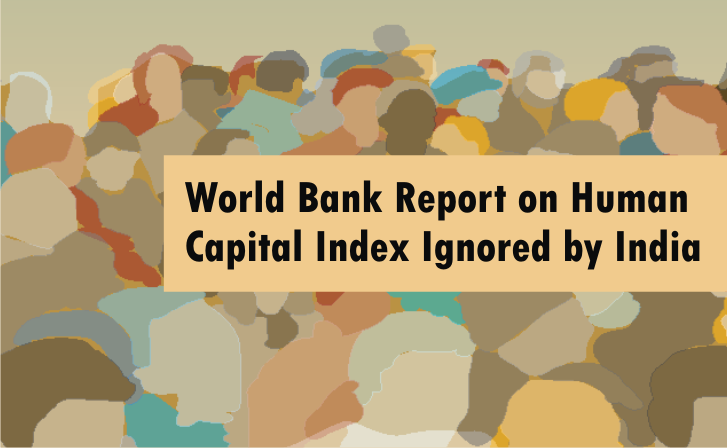
Human Capital Index (HCI): World Bank’s latest country rankings released as part of its Human Capital Project on Thursday 11 October 2018 with the purported objective to show how low education and health outcomes, or human capital, impact productivity, growth and prosperity; uses metric of industrial era to measure the status of human capital for digital age and its production system. India is ranked 115 out of 157 countries in the index, below the world average and below the average for South Asia. As per the HCI, much poorer neighbouring countries like Bangladesh and Nepal score better than India. Even compared with its peers in terms of GDP per capita, India’s score is lower than the average of middle-lower income countries. Government of India has decided to ignore as better metric is needed as the Human Capital needs to continuously evolve and develop. There is need to recognize that digital technological changes taking place are more fundamental than even invention of the steam engine, which had laid the foundation of the industrial revolution. There is a digital revolution which is transforming the world.
Structural Reforms in areas like taxation and bankruptcy are helping the Indian economy in building its resilience to global shocks and maintain a robust growth rate despite challenges.
Prudent policy measures have helped, and measures being undertaken now will also help contain the stress currently seen in financial condition tightening, and oil prices etc.
World Bank’s Human Capital Index (HCI), claims to seek to measure the amount of human capital that a child born today can expect to attain by age 18. The HCI index values are contended to convey the productivity of the next generation of workers, compared to a benchmark of complete standard education and full health. The HCI has three components:
- Survival, as measured by under-5 mortality rates;
- Expected years of Quality-Adjusted Schoolwhich combines information on the:
- Quantity of education as measured by harmonizing test scoresfrom major international student achievement testing programme, and
- Quality of education from number of years of school that a child can expect to obtain by age 18 given the prevailing pattern of enrolment rates across grades in respective countries); and
- Health environmentusing two proxies of:
- Adult survival rates and
- Rate of stunting for children under age 5.
HCI published for the first time on 11 October 2018 concludes that for 56% of the world’s population the HCI is at or below 0.50; and for 92% it is at or below 0.75. Hence only 8% of the population can expect to be 75% as productive as they could be.
HCI measures the Index outcomes for each country as a fraction of maximum value of 1. As expected the advanced economies such as North America and Europe mostly have HCI value of above 0.75, while South Asia and Sub Saharan Africa have the lowest HCI among the regions.
HCI for India has been estimated at 0.44. The quality adjusted learning has been measured in case of India by using the data as old as 2009. The key observations regarding HCI for India in the Report are as under:
- Human Capital Index: A child born in India today will be only 44% as productive when she grows up as she could be if she enjoyed complete education and full health. HCI in India for females is marginally better than that for males. There has been marked improvement in the HCI components in India over the last five years.
- Probabilities of Survival to Age 5: 96% of children born in India survive to age 5.
- Expected Years of School: In India, a child who starts school at age 4 can expect to complete 10.2 years of school by her 18th
- Harmonized Test Scores: Students in India score 355 on a scale where 625 represents advanced attainment and 300 represents minimum attainment.
- Learning-adjusted Years of School: Factoring in what children actually learn, expected years of school is only 5.8 years.
- Adult Survival Rate: Across India, 83% of 15-year olds will survive until age 60.
- Healthy Growth (Not Stunted Rate): 62% of children are not stunted. 38% of children are stunted, and so at risk of cognitive and physical limitations that can last a lifetime.
- Gender Differences: In India, HCI for girls is marginally higher than for boys.
As regards advisability and utility of this exercise of constructing HCI there are serious reservations, as there are major methodological weaknesses and substantial data gaps. Several key factors seem to have been neglected.
In India’s context the HCI score does not reflect the key initiatives that are being taken for developing human capital in the country, such as the following:
- Samagra Shiksha Abhiyan:launched to focus on access and quality of education for the benefit of 197 million school children.
- Ayushman Bharat Programme: world’s largest Health Insurance initiative providing 500 million citizens with adequate health coverage, and transforming 150,000 Health Centres into Wellness Centres to provide comprehensive primary healthcare services.
- Swachh Bharat Mission: Sanitation coverage expanded from 38% in 2014 to 83% in 2018, made possible through the construction of over 72 million toilets and simultaneous societal reforms driven through strong political will.
- Pradhan Mantri Ujjwala Yojana:that has reduced drudgery and improved the health of about 38 million women by providing them with LPG connection to replace firewood and coke based cooking stoves.
- Pradhan Mantri Jandhan Yojana: has provided access to formal banking services to over 328 million persons in pursuing with the agenda of financial inclusion. The share of account ownership among rural adults has more than doubled from 33% in 2011 to 79% in 2017, significantly bridging the rural-urban gap.
- Financial inclusion and Aadhaaridentification system has enabled India to make direct cash transfer of about US$ 64 billion to citizens, thus improving governance and social protection.
These initiatives are transforming human capital in India at rapid pace and very comprehensively touching upon the lives of millions of people living in rural and tribal areas. The qualitative aspects of improved governance that have a strong correlation with human capital development cannot be and have not been captured by the way the HCI has been constructed. The gap in data and methodology overlook the initiatives taken by a country and, in turn, portray an incomplete and pre-determined picture. The Government of India, therefore, has decided to ignore the HCI and will continue to undertake its path breaking programme for human capital development aiming to rapidly transforming quality and ease of life for all its children.
Related Articles
-
 Apr 26, 2017 12:15 pm






Related Articles
-
Created at: Jan 22, 2020
-

Created at: May 29, 2019
-

Created at: May 28, 2019
-

Created at: May 28, 2019
-

Created at: May 27, 2019
-

Created at: May 27, 2019
-

Created at: May 26, 2019