
Social Media
World’s Largest Amphibious Aircraft – AG600 Takes Off in China
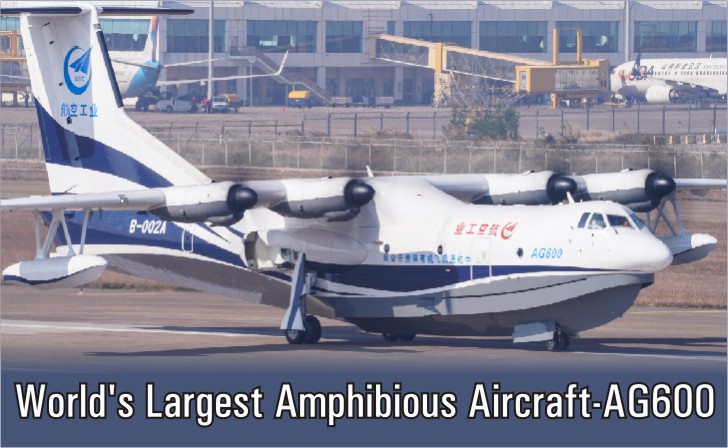
World’s largest amphibious aircraft, codenamed Kunlong, China’s home-grown AG600, took off from southern city of Zhuhai and landed after hour-long flight on Sunday 24 December 2017; its successful maiden flight makes China among the world’s few countries capable of developing a large amphibious aircraft. AG600’s chief designer is Huang Lingcai. China’s state media Xinhua described the plane as “protector spirit of the sea, islands and reefs”. AG600’s flight capabilities put all of China’s island-building projects in the South China Sea well within range. The amphibious aircraft has military applications but will be used for fire-fighting and marine rescue.
- AG600 aircraft has a wingspan of 38.8 metres (127ft)
- Is powered by four turboprop engines
- Can stay airborne for 12 hours.
- Has 4500km operational range
- Maximum take-off weight of 53.5 tonnes.
- It can use conventional airports and
- Has ability to land and take off from Sea
- Is capable of carrying 50 people during maritime search-and-rescue missions
- Can scoop up 12 metric tons of water within 20 seconds for fire fighting trips, to battle forest fire
- The plane’s capacity and manoeuvrability makes it ideal for transporting material to those maritime features that are too structurally fragile to support runways.
- State-owned Aviation Industry Corp of China (AVIC) has spent almost eight years developing the aircraft
- Aircraft has received 17 orders so far from Chinese Government Departments and Chinese Companies.
AG600 is around the size of a Boeing 737, but it is considerably smaller than billionaire Howard Hughes’ flying boat ‘H-4 Hercules’ better known as the ‘Spruce Goose’, which had a wingspan of 97.54 metres and a length of 67 metres but only made one brief flight, which lasted about 26 seconds, in 1947, and never flew again. It is on display in a museum in Oregon.
‘Martin Mars Seaplane’ was made by the Glenn L Martin Company as a World War II Transporter for the US Navy and has a wingspan of 61 metres.
Some were later adapted as Water Bombers and have been in service in Canada on fire-fighting duties.
The Russian-built ‘Beriev A-40 Albatros’ had a wingspan of 41.62 metres, but only two were fully or partially built. The first flight was in 1986 and the project was suspended.
China is in the midst of a massive military modernisation programme, ranging from testing Anti-Satellite Missiles to building Stealth Fighters. Earlier this year, in 2017, it launched its first domestically built Aircraft Carrier, the ‘Type 001A’. This complemented the Liaoning, a second hand Soviet carrier bought from Ukraine and commissioned in 2012 after extensive refits.
The launch of this new Amphibian Aircraft AG600 further strengthens China’s rapidly modernising military.
China’s military expenditure in 2016 was an estimated $215bn, according to the Stockholm International Peace Research Institute, putting it in first place in Asia, well ahead of India ($56bn), Japan ($46bn) and South Korea ($37bn).
China has stepped up research on advanced military equipment as it adopts a more muscular approach to territorial disputes in places such as the disputed South China Sea, rattling nerves in the Asia-Pacific region and the United States.
Related Articles
-
 Feb 25, 2017 11:43 am




Related Articles
-
Created at: May 29, 2019
-

Created at: May 28, 2019
-
Created at: May 27, 2019
-

Created at: May 27, 2019
-

Created at: May 26, 2019
-
Created at: May 26, 2019
-

Created at: May 25, 2019