
Social Media
Deep Ocean Mission to Explore Deep Recesses of Ocean
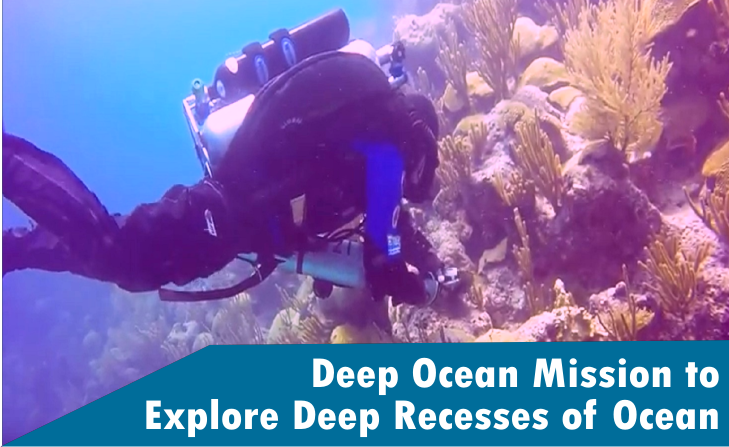
Deep Ocean Mission has been planned to explore the deep recesses of the ocean and its blueprint has been unveiled on Friday July 27, 2018 with a five-year ₹8000 crore plan in which Ministry of Earth Sciences, Government of India is tasked with coordinating the exercise and proposal has been submitted to the Prime Minister’s Office. This will improve India’s position in ocean research field. An Offshore Desalination Plant that will work with tidal energy; Deep Ocean Energy; Deep Sea Science and Fisheries; Minerals and Poly-metallic Nodules; and developing a Submersible Vehicle that can go to a depth of at least 6000 meters with three people on board are the major components of the mission. The focus will be on technologies for deep-sea mining, underwater vehicles, and underwater robotics and ocean climate change advisory services, among other aspects.
Based on the resource evaluation, India has been allotted a site of 75,000 square kilometres with an estimated resource of about 100 million tons of strategic metals such as Copper, Nickel, and Cobalt besides Manganese and Iron; in the Central Indian Ocean Basin (CIOB) by the UN International Sea Bed Authority for exploitation of poly-metallic nodules (PMN). Poly-metallic nodules, also called manganese nodules, are rock concretions on the sea bottom formed of concentric layers of iron and manganese hydroxides around a core.
- A First Generation Mine-site (FGM) with an area of 18,000 sq km has been identified.
- Latest technologies for extraction of metals from the minerals have also been developed under the programme.
- India’s Exclusive Economic Zone spreads over 2.2 million square kilometres and in the deep sea, lies unexplored and unutilised.
- An estimated that 380 million metric tonnes of poly-metallic nodules are available at the bottom of the seas in the Central Indian Ocean.
- Detailed environmental data has been collected for compliance with International Seabed Authorities requirements.
- Besides identifying the mineral resource and developing technologies for mining and extraction, the programme has also resulted in high impact research as well as manpower development.
- It is envisaged that 10% of recovery of that large reserve can meet the energy requirement of India for the next 100 years.
- Programme on Poly metallic nodules was initiated at CSIR-NIO with the collection of the first nodule sample from Arabian Sea on board the first Research Vessel Gaveshani on 26 January 1981.
- India was the first country in the world to have been given the Pioneer Area for exploration of deep-sea mineral viz. Poly-metallic nodules in the Central Indian Ocean Basin in 1987.
- This was based on the extensive surveys carried out by the scientists of CSIR-NIO, on several research ships leading to the allocation of an area of 150,000 sq km to the country with exclusive rights under the UN Law of the sea.
Related Articles
-
 May 26, 2019 17:00 pm








Related Articles
-

Created at: May 29, 2019
-
Created at: May 28, 2019
-

Created at: May 28, 2019
-
Created at: May 27, 2019
-

Created at: May 27, 2019
-
Created at: May 26, 2019
-
Created at: May 26, 2019