
Social Media
Organic Farming for Sustainability, Food Safety, & Biological Diversity
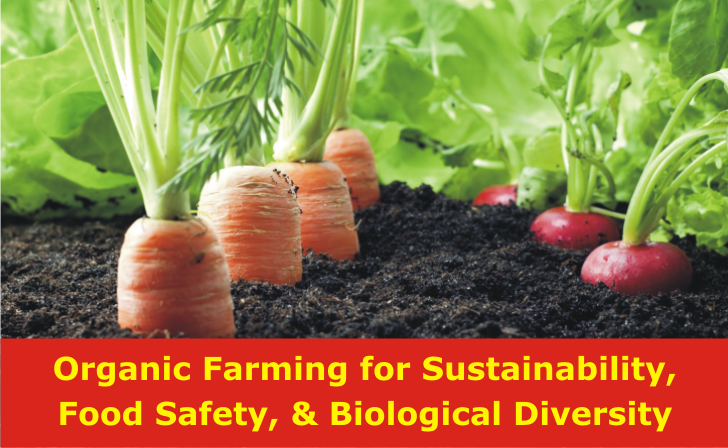
Organic farming is gaining prominence in India due to the fact that the more organic and natural the produce – the safer and healthier it is, for us and for the environment. Union Minister for Agriculture & Farmers Welfare Radha Mohan Singh visited on Sunday July 29, 2018 Lawsohtun organic farm at Shillong in Meghalaya, which is spread over 4 hectare belongs to Lawsohtun Farmers’ Association and is maintained by 20 households. The minister appreciated the work of farmers for practicing organic farming and encouraged them to expand their practice of organic farming to more lands. He assured full support from the Central government towards promoting organic farming in the state and asked the State government officials to invest more resources towards practicing and promoting organic farming in the state and to extend all possible assistance to farmers in this effort. Farming community as well as the city dwellers are now increasingly adopting organic farming practices and reaping more benefits as can be observed from the increasing number of individuals venturing into this field. Sustainability, openness, self-sufficiency, autonomy, health, food security and food safety are some of the advantages of organic farming.
Organic farming is an alternative agricultural system which to the maximum extent feasible relies upon crop rotations, crop residues, green manure, animal manures, compost manure, off-farm organic waste, mineral grade rock additives and biological system of nutrient mobilisation and plant protection; and avoids or largely excludes the use of synthetic inputs, such as fertilisers, pesticides, hormones, feed, etc., and genetically modified organisms, and growth hormones. Biological pest control; mixed cropping and companion planting; and fostering of insect predators are encouraged. It’s an integrated farming system that strives for sustainability, enhancement of soil fertility and biological diversity.
Organic farming as a concept is not new as it originated early in the 20th century in reaction to rapidly changing farming practices, and we are now seeing a rise in organic farming, as consumers are becoming highly conscious about their health and foods they consume, more and more people are opting for organic food to avoid the consumption of foods that are grown using chemical preservatives.
According to a study jointly by Assocham and Ernst & Young:
- Organic products market in India has been growing at a compound annual growth rate (CAGR) of 25% and it is expected to touch ₹10000-₹12000 crore by 2020 from the current market size of ₹4000 crore
- India has although the highest number of farmers currently engaged in organic farming at 835000, yet the country accounts for less than 1% of the global organic market pie valued at $90 billion in 2016.
- India ranks at 9th position with 1.49 million hectares in terms of total area under organic cultivation. Australia, which tops the list, has more than 27 million hectares under organic farming.
- India’s organic packaged food and beverages is an emerging niche market and its primary consumers are high-income urbanites.
- India’s organic packaged food market size growing at a rate of 17 per cent is expected to cross ₹1 crore by 2021 from ₹53.3 crore in 2016.
- “The substantial growth of this sector is attributed to an expanding urban population base, rising health concerns, growing consumer spending on food products and deterioration of food quality”.
- Apart from organic food and beverages markets, health and wellness, beauty and personal care market opportunities have grown immensely.
- India is the second largest exporter of organic products in Asia after China.
- Indian organic cultivation is highly successful due to the increasing export market coupled with the Government’s support.
- “One of the major challenges faced by consumers who buy organic products by paying so much premium is that whether they can trust the product to be authentic or not”.
Meghalaya should become “100% organic farming state” as per expectations of the Central Government, as the state is rooted in a rich organic farming tradition. Government of Meghalaya had launched a new initiative called ‘Mission Organic’ in January 2015 to promote organic farming methods. Meghalaya has already developed organic farming in 40,000 hectares of land, covering all the districts of Meghalaya and this practice will complete three years on March 2019, according to Government officials of Meghalaya. This will enable the state to get the necessary certification for the products of these lands as organic products.
Among the states, Madhya Pradesh has the largest area under organic certification (4.62 lakh ha) followed by, Maharashtra (1.98 lakh ha) Rajasthan (1.55 lakh ha), Telangana (1.04 lakh ha), Odisha (0.96 lakh ha), Karnataka (0.94 lakh ha), Gujarat (0.77 lakh ha) and Sikkim (0.76 lakh ha). These states had a combined share of 90% of the area under organic certification in 2015-16.
Related Articles
-
 May 24, 2018 12:00 pm








Related Articles
-

Created at: May 29, 2019
-

Created at: May 28, 2019
-

Created at: May 28, 2019
-

Created at: May 27, 2019
-

Created at: May 27, 2019
-

Created at: May 26, 2019
-
Created at: May 26, 2019