
Social Media
Pressurized Heavy Water Reactors to Boost India’s Nuclear Energy
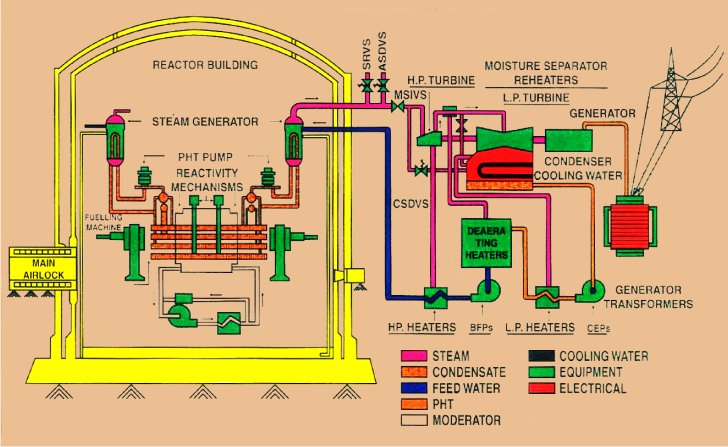
India’s nuclear power sector gets a boost under the flagship “Make in India” projects, with Cabinet giving approval, on Wednesday 17 May 2017, for construction of 10 units of India’s indigenous Pressurized Heavy Water Reactors (PHWR) having total installed capacity of 7000 MW; with the commitment to prioritize use of clean power in India’s energy mix, as part of low-carbon growth strategy and to ensure long-term base load requirement for the nation’s industrialization. These 10 PHWR project will result in a significant augmentation of nuclear power generation capacity and support India’s commitment to sustainable development, energy self-sufficiency and bolster global efforts to combat climate change. This approval also marks a statement of strong belief in the capability of India’s scientific community to build own technological capacities. It underscores the mastery our nuclear scientists have attained over all aspects of indigenous PHWR technology. India’s record of building and operating PHWR reactors over the last nearly forty years is globally acclaimed.
Highlights of the project are:
- It is a major step towards strengthening India’s credentials as a major nuclear manufacturing powerhouse.
- Ten reactors (nuclear power plants) will be part of India’s latest design of 700 MW PHWR fleet with state-of-art technology meeting the highest standards of safety.
- Project will bring about substantial economies of scale and maximize cost and time efficiencies by adopting fleet mode for execution.
- Project will create business worth Rs 70,000 crore.
- Project will generate more than 33,400 jobs in direct and indirect employment.
- Based on latest technology that uses heavy water as its coolant and neutron moderator in a nuclear reactor. Pressurized Heavy Water Reactors use un-enriched uranium that is available in India, as its fuel.
- This will reduce India’s dependence on imports for nuclear fuel and reactors. India imports uranium, the fuelling for firing a nuclear plant and also is entirely dependent on foreign companies for providing reactors.
- Design and development of this project is a testament to the rapid advances achieved by India’s nuclear scientific community and industry.
The new reactors would be in addition to the ones that are expected to come on-stream by 2021-22, boost the nuclear power sector whose contribution to India’s energy mix is a mere 3.5% from an installed capacity of 6780 MW from 22 reactors. The reactors under construction are Kudankulam, Kakrapar and Rajasthan Atomic Power Plant (RAPP). The 10 reactors will be built at Mahi Banswara (Rajasthan), Chutka (Madhya Pradesh), Kaiga (Karnataka) and Gorakhpur (Haryana).
Related Articles
-
 Apr 14, 2018 12:00 pm








Related Articles
-
Created at: Jan 22, 2020
-

Created at: Nov 2, 2019
-

Created at: May 28, 2019
-

Created at: May 28, 2019
-

Created at: May 27, 2019
-

Created at: May 27, 2019
-

Created at: May 26, 2019