
Social Media
“Saraswati Supercluster” Discovery would shed Light on Density Clusters Formed Billions of Years Ago
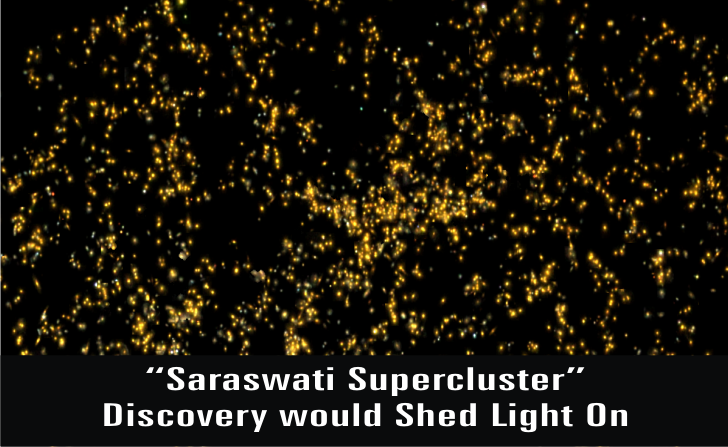
A Supercluster of galaxies discovered by Indian astrophysicists prior to February 2016, is one of the largest, most massive and the furthest superclusters known that has been named “Saraswati Supercluster”. This supercluster is as big as 20 million billion suns, roughly more than 10 billion years old, about 4 billion light years away from Earth and spreads over a “great wall” about 600 million light years across. Saraswati Supercluster was discovered by Shishir Sankhyayan, a PhD student at the Indian Institute of Science Education and Research (IISER), Pune, Pratik Dabhade, Inter-University Centre for Astronomy and Astrophysics (IUCAA) research fellow, Joe Jacob of the Newman College, Kerala, and Prakash Sarkar of the National Institute of Technology, Jamshedpur. “There are basically only four or five known superclusters of this size in the entire universe. So, this discovery is a rare find”. These findings of the team led by IUCAA Director Somak Raychaudhary have been published in The Astrophysical Journal, the premier research journal of the American Astronomical Society
- Superclusters, the clusters of clusters, are the largest coherent structures in the cosmic web, the universe.
- A supercluster initially was used to describe groups of two-four clusters, now it is understood that much larger superclusters, comprising clusters that number an order of magnitude higher, exist.
- A supercluster could have clusters ranging from 40 to 43 and superclusters with two to four clusters are common, Saraswati has 42 clusters.
- Superclusters are a chain of galaxies and galaxy clusters, bound by gravity, often stretching to several hundred times the size of clusters of galaxies, consisting of tens of thousands of galaxies.
- Large groups of clusters, separated by voids, connected by filaments and sheets of dark matter with galaxies embedded in them, together form the superclusters.
- It is supposed that the galaxies are born in the filaments and then migrate towards the intersection of the filaments where they are assimilated into clusters.
- Galaxies are themselves made of billions of stars and planets, and are like the building blocks of the universe.
- Galaxy Cluster term was first used in 1926 when Harlow Shapley and Adelaide Ames coined the term “cluster” to describe a collection of galaxies to describe the Coma-Virgo region. The term “Virgo cluster” was first used by Edwin Hubble and Milton Humason in 1931.
- Galaxy groups can have three to 20 galaxies.
- Clusters are the richest systems, like the Virgo cluster, which could roughly have galaxies ranging from 1000 to 10,000.
- Superclusters are relatively recent finds, having been identified for the first time only in the 1980s.
- The first such large supercluster of galaxies, the Shapley Supercluster, was discovered in 1989, by Professor Somak Raychaudhury, who is presently director of Inter University Centre for Astronomy and Astrophysics (IUCAA), Pune, had discovered a supercluster as part of his PhD thesis work at University of Cambridge. It was named “Shapley Supercluster,” after the American astronomer Shapley who first coined the term cluster. Shapley’s work in measuring the extent of galaxies is remarkable and a part of extending the Copernican programme – establishing that the earth is not the centre of the universe.
- The second supercluster, the Sloan Great Wall in was discovered 2003,
- The Milky Way, our own galaxy is part of the Laniakea Supercluster, which was discovered in 2014 and is referred to as Akash Ganga.
- Saraswati supercluster is 600 million light years across. The Milky Way is 150,000 light years across.
- Saraswati lies in the Stripe 82 of the Sloan Digital Sky. It is about 4000 million light years away from us. It is in the constellation of Pisces.
- Sloan Digital Sky Survey (SDSS) is an ambitious plan to make a digital 3D map of the universe. Started in 2000, it has, in over eight years mapped more than a quarter of the sky. It has mapped nearly 930000 galaxies. SDSS has found nearly 50 million galaxies so far. In its third phase, SDSS-III, which started in 2008 and ended in 2014, gave out sets of data that were released in 2011, 2012 and 2013. It produced a map of the North Galactic Cap which stretched to 7500 square degrees and of three stripes in the South Galactic Cap which added to 740 square degrees. The central stripe is known Stripe 82.
Significance of Discovery of “Saraswati Supercluster”:
Joydeep Bagchi from IUCAA, the lead author of the paper in the journal, and co-author Shishir Sankhyayan said they were “astonished to spot this giant wall-like supercluster of galaxies”, visible in a large spectroscopic survey of distant galaxies, known as the Sloan Digital Sky Survey. The data was then analysed, following which the discovery was made. “This supercluster is clearly embedded in a large network of cosmic filaments traced by clusters and large voids”. The two hoped that the work would help shed light on “perplexing questions” like how such matter- density clusters had been formed billions of years ago.
Shishir Sankhyayan added, “Since our information is based on signals received from stars at such massive distance, we are essentially looking into the past of the universe, as light from these stars has taken about four billion years in reaching us. It is around this time, scientists believe, that dark energy, about which we know little, had begun to dominate the space in the universe. The study of Saraswati therefore is likely to offer more insight into our understanding of dark energy”.
Spotting a supercluster that is a massive concentration of galaxies and galaxy clusters, which is 4000 million (4 billion) light years away means you are looking at light that has come in from four billion years ago. This is because a light year is the distance travelled by light in one year. Since the universe is believed to be 13.8 billion years old, this means we are looking at light from when the universe was about 10 billion years old, just about 70% of its present age.
Joydeep Bagchi, feels that the project has demonstrated the expertise of Indian researchers, particularly those at IUCAA, “India has already become a world leader in the field of radio astronomy with the successful operation of the 100% indigenous Giant Meterwave Radio Telescope (GMRT) near Pune, which is currently the world’s largest and most powerful radio telescope in meter wavelength range. Moreover, with the highly successful Mars Orbital Mission, Indian space scientists have demonstrated to the world that they can execute extremely complex and precise space missions at much lower costs than advanced nations.”
For Shishir Sankhyayan, co-author in the research paper, the main challenge was analysis of the data and refining it. “While India has cutting edge facilities in major research institutes, improvement in the environment research and facilities in some of the universities is still required.” His plans include exploring the Saraswati Supercluster in details and searching for more superclusters, if they exist, in our universe.
Related Articles
-
 Feb 20, 2017 12:35 pm






Related Articles
-

Created at: Nov 2, 2019
-

Created at: May 29, 2019
-
Created at: May 28, 2019
-

Created at: May 28, 2019
-
Created at: May 27, 2019
-
Created at: May 27, 2019
-

Created at: May 26, 2019