
Social Media
Supreme Court may decide Validity of Article 35A & 370
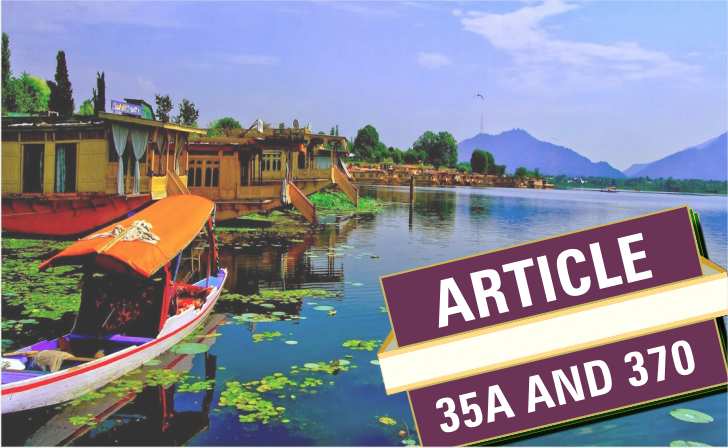
Validity of Articles 35A and 370 may ultimately be decided by a Constitution Bench as had recently been indicated by the Supreme Court. However, the Court listed the petitions regarding Article 35A for the last week of February 2018, after the Centre filed a petition for postponement in the wake of the appointment of special representative Dineshwar Sharma, a former IB director, on Jammu and Kashmir to hold talks with stakeholders. The court is hearing a writ petition filed by NGO, ‘We the Citizens’, which challenges the validity of both, Article 35A and Article 370. A second petition filed by Jammu and Kashmir native Charu Wali Khanna has challenged Article 35A for protecting certain provisions of the Jammu and Kashmir Constitution, which restrict the basic right to property if a native woman marries a man not holding a permanent resident certificate.
Article 35A is a provision incorporated in the Indian Constitution giving the Jammu and Kashmir State Legislature a carte blanche to decide who are the ‘permanent residents’ of the State and grant them special right and privileges in State public sector jobs, acquisition of property within the State, scholarships and other public aid and welfare programmes. The provision mandates that no act of the State legislature coming under the ambit of Article 35A can be challenged for violating the Indian Constitution or any other law of the land.
Article 35A was incorporated into the Indian Constitution in 1954 by an order of the then President Rajendra Prasad on the advice of the Jawaharlal Nehru Cabinet. The Presidential Order was issued under Article 370 (1) (d) of the Indian Constitution. This provision allows the President to make certain “exceptions and modifications” to the Constitution for the benefit of ‘State subjects’ of Jammu and Kashmir. So Article 35A was added to the Constitution as a testimony of the special consideration the Indian government accorded the ‘permanent residents’ of Jammu and Kashmir. Parliament was not consulted when the President incorporated Article 35A into the Indian Constitution through a Presidential Order issued under Article 370. Article 368 (i) of the Constitution mandates that only the Parliament can amend the Constitution by introducing a new Article.
Article 370 gives autonomous status to the state of Jammu & Kashmir. The article is drafted in Part XXI of the Constitution: Temporary, Transitional and Special Provisions.
Petitioners challenge special status vide writ petition filed by NGO, ‘We the Citizens’:
- Article 370 was only a ‘temporary provision’ to help bring normalcy in Jammu and Kashmir and strengthen democracy in that State.
- The Constitution makers did not intend Article 370 to be a tool to bring permanent amendments, like Article 35A, in the Constitution.
- Article 35A is against the “very spirit of oneness of India” as it creates a “class within a class of Indian citizens”.
- Restricting citizens from other States from getting employment or buying property within Jammu and Kashmir is a violation of fundamental rights under Articles 14, 19 and 21 of the Indian Constitution.
A second petition filed by Jammu and Kashmir native, Charu Wali Khanna, has challenged:
- Article 35A for protecting certain provisions of the Jammu and Kashmir Constitution which restricts the basic right to property if a native woman marries a man not holding the Permanent Resident Certificate. As per the petition, “Her children are denied a permanent resident certificate, thereby considering them illegitimate”.
However, in a landmark judgement, in October 2002, the full bench of J&K High Court, with one judge dissenting, held that the daughter of a permanent resident of the State will not lose her permanent resident status on marrying a person who is not a permanent resident, and will enjoy all rights, including property rights.
Related Articles
-
 Feb 27, 2017 06:52 am

Related Articles
-
Created at: Jan 22, 2020
-

Created at: Nov 2, 2019
-

Created at: May 29, 2019
-

Created at: May 28, 2019
-

Created at: May 28, 2019
-

Created at: May 27, 2019
-
Created at: May 27, 2019