
Social Media
India Completes Nuclear Triad with INS Arihant – Deterrence Patrol
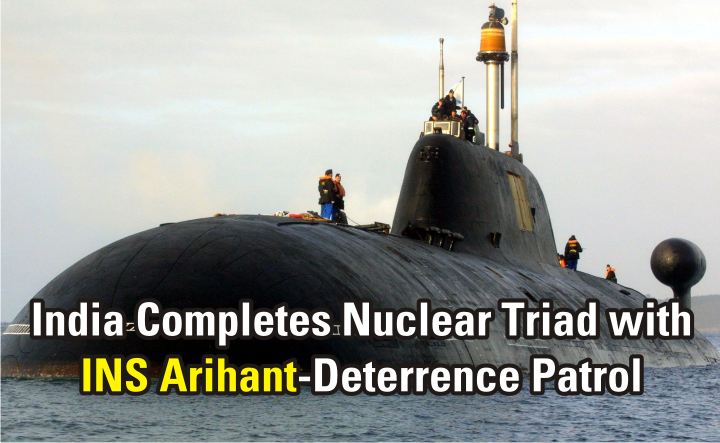
INS Arihant: Strategic Strike Nuclear Submarine (SSBN), India’s first nuclear ballistic missile submarine, completed on Monday 5 November 2018, deterrence patrol – India’s nuclear-triad, which means the country can now fire nuclear ballistic missiles at enemy from land, sea and air. Mirage 2000s and Agni ballistic missiles complete the other two air and land components of India’s nuclear triad. The successful establishment of the nuclear triad place India in the league of the few countries that can design, construct and operate SSBN. USA, Russia, France, China and UK are the other five big nuclear nations that are already full-fledged nuclear triad powers. INS Arihant will provide India’s nuclear deterrent as once the submarine disappears underwater; it becomes virtually impossible to locate and can remain on patrol for months, with its ballistic missiles ready for launch on the orders of Nuclear Command Authority (NCA) whose chief is the Prime Minister.
Prime Minister Narendra Modi congratulating the crew of the INS Arihant on having established the capabilities of our nuclear weapons, termed it as an “important pillar of global peace and stability”, and added “With the increase in nuclear arms, a credible nuclear deterrence is very important for our country”.
- Arihant is said to be the one who has the ability to destroy the enemy, in Hindi it means दुश्मन कोनष्ट करना.
- INS Arihant submarine project was under development for around three decades as part of a highly classified programme.
- The project was launched on 26 July 2009.
- The submarine following extensive sea trials was commissioned into the Indian Navy in August 2016.
- INS Arihant built as part of Advanced Technology Vessel (ATV) project at the Ship Building Centre at Visakhapatnam, based on the Russian Akula-1 class submarine, is now ready for complete operations.
- This nuclear-capable ballistic missile submarine has the capability to sail closer to the coast of the enemy nation and fire ballistic missiles deep into the territory.
- The submarine is capable of carrying 12 K-15 submarine-launched ballistic missiles that have a range of over 700 kilometres
- Fail-safe electronic permissive action links have been installed to ensure instant compliance with an authorised launch command from the NCA.
- Its weight is 6000 tonne.
- Its Length is 111 Metre.
- Its submerged speed is 24 knots (44 km/h; 28 mph) and surfaced speed is 15 knots (28 km/h; 17 mph).
- It can travel up to a range of 3500 kilometres.
India presently operates an 8140 tonne Russian nuclear-powered submarine called INS Chakra, which is on a 10-year leave since April 2012.
INS Arihant, apart from its strategic significance, is a live manifestation of Prime Miniter Modi’s “Make in India” vision. A number of major private-sector companies contributed to the Advanced Technology Vessel programme by mastering esoteric technologies to design and fabricate systems for the vessel. Indian small and medium industries have contributed components manufactured to high precision and reliability specifications that spawned a huge country-wide indigenisation process under the Indian Navy managed DRDO project.
As a responsible nation, India has put in place a robust nuclear command and control structure, effective safety assurance architecture and strict political control, under NCA. It remains committed to the doctrine of Credible Minimum Deterrence and No First Use, as enshrined in the decision taken by the Cabinet Committee on Security in its meeting chaired by the then Prime Minister Atal Bihari Vajpayee on January 04, 2003.
Related Articles
-
 May 05, 2018 17:00 pm





Related Articles
-

Created at: May 29, 2019
-

Created at: May 28, 2019
-

Created at: May 27, 2019
-

Created at: May 27, 2019
-

Created at: May 26, 2019
-
Created at: May 26, 2019
-

Created at: May 25, 2019